The local shepherd, Antoine, had parked his sheep down the track among the olive trees that belong to our neighbour, Sebastien, who owns the small local Presse.
A dozen or so sheep gave birth in mid-April and they and their lambs were guarded against thieves and dogs by Babar, a huge white-blonde Pyrenean mountain dog. Babar is a bit prone to wandering it seems, so he has a block of something-or-other, not too heavy, around his neck to discourage him from straying.
Last week as I was getting ready to go to Paris for a few days I drove down the road and saw that the temporary barrier round the sheep was lying flat. Two sheep and several lambs were mooching around grazing by the road.
I stopped the car, got out and tried to shepherd them back into the pen but they just wandered further away. Babar, I noticed, wasn't around.
The sheep and new lambs were in danger not just from cars that might pass on the track but also from the little canal just nearby.
As I didn't have Antoine's phone number, I drove to the village and went to the Presse. Sebastien would have the number. But Sebastien was away for the day and his assistant couldn't help. I went to the small local bar and asked a few of the guys if they knew Antoine. One guy did but had no idea how to reach him. Try the Police Municipale they all said.
I didn't much want to go to the police. For all I know, Antoine's sheep are non declarés and he might end up in trouble for not paying taxes. So I went to the fire station. In rural France, firemen are like a cross between an emergency service, a general maintenance team and social glue. A tall handsome fireman who looked like the American actor James Stewart greeted me. After listening to my worry that the sheep would be hit by cars and the lambs would fall into the canal he explained that his team of pompiers can go out to manage stray horses but not stray sheep. Still, he said, he'd phone his colleague Lionel Toutlemonde because, as his name suggests, Lionel knows everyone.
Lionel, however, didn't have a number for Antoine and I ended up running into a neighbour who did.
We called Antoine and he arrived within half an hour, speeding up the track in his beat-up van.
I hung around in the little hamlet just nearby to see what the outcome would be and he came to find me after an hour or so. Babar had pitched up when Antoine called out for him. He had a bad gash on his neck and had obviously been in a scrap with another dog. His lovely pale fur was bloodied and matted. He looked rather cowed. Presumably he'd chased his marauding rival over the fence, flattening it in the process.
All the sheep were accounted for and Antoine had returned them to the pen. But, sadly, one of the lambs had died. Had it been attacked, I asked? No, he said. It was just lying, peacefully, dead. A percentage of the new lambs will always die, he said philosophically.
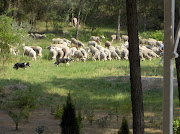
I drove down the road today and stopped to have a look at the little troop. It was hot and sunny - a still, calm spring day in Provence - and the lambs were mostly snoozing in the sun beside their mothers. They looked sublimely comfortable in the long grass beneath the still olive trees. One or two were nibbling at flowers and a couple of the sheep were clipping leaves from the olive trees. It was a beautiful rural scene, completely peaceful.
I drove off and spotted Antoine's van arriving further down the road. He stopped and leant out of the window.
"I just passed them" I told him.
"Are they all right?"
"They're fine. Very peaceful. Grazing, dozing."
"Babar still with them?"
"Yes, he's there."
"Good" he said. "Not long now and they'll be off to the butcher's."
Which disrupted my sweet image somewhat. But that's Provence. The people, the animals, the land and the dinner table are strictly and closely connected.
Tuesday, April 19, 2011


Tuesday, April 12, 2011
The arrival of spring in Provence
One of the great things about Provence is that the seasons are clearly demarcated and tend to arrive bang on time each year. Now that it's spring, the region is opening out just as you feel it should. For one thing, it's suddenly warm and sunny and the air has that strange uplifting scent that's a mix of optimism, blossom, flowering plants and fertility. There are songbirds everywhere. Leaves have appeared on the vines. The cherry blossom opened for a week and has now gently drifted off into oblivion leaving the very beginnings of fruit behind. My forest garden is suddenly sprouting yards of tangled asparagus, poppies, white and pink thyme and garrigue-y grass. The vines by the terrace are unfolding leaves that I'll use for stuffed vine leave dishes in a few weeks. And the honeysuckle, lazy and dormant all winter, is suddenly rampant and climbing all over the place. It's been desperately in need of pruning.
Yesterday evening I stopped to look at the dozen or so sheep which the local shepherd, Antoine, has stationed next to the canal nearby. They've just given birth so there are about 16 little brown lambs, with white tails and white flashes on their foreheads, jumping around among the olive trees.
Their bodyguard, a large white dog (Pyrenean mountain, I think) was lounging in the long grass, just keeping an eye out as he dozed. I watched the lambs gambolling around for a while as their mothers lay panting with exhaustion. Antoine turned up in his van to fill a tub of water for them and check the lambs. He hopped over the flimsy, temporary fence he'd put up and greeted his dog. I asked what the dog would do if I crossed the fence. "Nothing" he said. "You're with me." "What would he do if I crossed once you've gone?" I asked.
He started laughing. "He'd tear your leg off" he replied.
Hard to imagine, since the dog looks like a great big softie but I didn't test the claim. And I suppose the sheep dogs are capable of aggression since they do need to confront sheep stealers. I have friends in Le Thor, a local village, who recently had two sheep stolen and then a lamb. In their case they have two Dobermans but both dogs were in the house that night.
I asked Antoine if he can bring the sheep up to my place to graze in a few days and he agreed. He'll lead them and their bodyguard up the white limestone track when the grass runs out by the canal. I've only cut the lawn twice in the last 4 years because I seem to have a lawnmower made for men. You need to pull a stiff cord out very quickly for some reason and I don't have the strength to do it. The sheep are a much nicer lawnmower, pleasant to watch, don't make a horrible noise, don't require petrol and fertilise the land as they mow.
Since everyone in Provence is now outside for the next six months and leaf, bud and flower are breaking out everywhere I decided to get outside too and prune the honeysuckle. Yesterday a neighbour gently reminded me that it was high time. So this morning I took the secateurs and made a start. I have a general idea that I need to remove the dead wood and select the branches that I want to retain. But mostly I tried to cut confidently and decisively, as if somehow that would help. Clearly it didn't because another neighbour, out for a stroll in the forest, trundled over to give an opinion. With a rueful smile he said: "You haven't really got green fingers have you?" (The French use the same phrase.)
Never mind. I stopped for a coffee and we watched riders go by on horses, followed by a couple of fit-looking guys on bikes. There was that spring scent again, the one that brings just about every Provencal man, woman and child outside. We'll live outside now, mostly, until around the end of September. And just as the leaves and buds and flowers appear, so do the the bare arms and legs. Summer clothes are suddenly everywhere. People are flirting outside bars and in the street. Pretty young girls drift past the village boys, casting a backward glance or striking up conversation. There's a kind of pulse beating that beats here every spring. And everyone and everything feels it, from the honeysuckle and the cherry trees to the horseriders and cyclists to the new lambs jumping blissfully around in the long grass. Finally, after the long cold winter, the beaux jours are here.
Yesterday evening I stopped to look at the dozen or so sheep which the local shepherd, Antoine, has stationed next to the canal nearby. They've just given birth so there are about 16 little brown lambs, with white tails and white flashes on their foreheads, jumping around among the olive trees.
Their bodyguard, a large white dog (Pyrenean mountain, I think) was lounging in the long grass, just keeping an eye out as he dozed. I watched the lambs gambolling around for a while as their mothers lay panting with exhaustion. Antoine turned up in his van to fill a tub of water for them and check the lambs. He hopped over the flimsy, temporary fence he'd put up and greeted his dog. I asked what the dog would do if I crossed the fence. "Nothing" he said. "You're with me." "What would he do if I crossed once you've gone?" I asked.
He started laughing. "He'd tear your leg off" he replied.
Hard to imagine, since the dog looks like a great big softie but I didn't test the claim. And I suppose the sheep dogs are capable of aggression since they do need to confront sheep stealers. I have friends in Le Thor, a local village, who recently had two sheep stolen and then a lamb. In their case they have two Dobermans but both dogs were in the house that night.
I asked Antoine if he can bring the sheep up to my place to graze in a few days and he agreed. He'll lead them and their bodyguard up the white limestone track when the grass runs out by the canal. I've only cut the lawn twice in the last 4 years because I seem to have a lawnmower made for men. You need to pull a stiff cord out very quickly for some reason and I don't have the strength to do it. The sheep are a much nicer lawnmower, pleasant to watch, don't make a horrible noise, don't require petrol and fertilise the land as they mow.
Since everyone in Provence is now outside for the next six months and leaf, bud and flower are breaking out everywhere I decided to get outside too and prune the honeysuckle. Yesterday a neighbour gently reminded me that it was high time. So this morning I took the secateurs and made a start. I have a general idea that I need to remove the dead wood and select the branches that I want to retain. But mostly I tried to cut confidently and decisively, as if somehow that would help. Clearly it didn't because another neighbour, out for a stroll in the forest, trundled over to give an opinion. With a rueful smile he said: "You haven't really got green fingers have you?" (The French use the same phrase.)
Never mind. I stopped for a coffee and we watched riders go by on horses, followed by a couple of fit-looking guys on bikes. There was that spring scent again, the one that brings just about every Provencal man, woman and child outside. We'll live outside now, mostly, until around the end of September. And just as the leaves and buds and flowers appear, so do the the bare arms and legs. Summer clothes are suddenly everywhere. People are flirting outside bars and in the street. Pretty young girls drift past the village boys, casting a backward glance or striking up conversation. There's a kind of pulse beating that beats here every spring. And everyone and everything feels it, from the honeysuckle and the cherry trees to the horseriders and cyclists to the new lambs jumping blissfully around in the long grass. Finally, after the long cold winter, the beaux jours are here.
Thursday, April 7, 2011
Falling in love in Provence
Since 2004, I've lived along a white limestone track in pine forest near Isle sur Sorgue in Provence. I wanted to live in Provence since I woke up on the sleeper train in Avignon in 1975 and stepped out onto a platform suffused with fabulous sunlight. It wasn't my first visit to France but it was my first time in Provence and it was love at first sight.
Now that I do live here, I fall in love over and over again each year. Usually in spring and summer. This morning for example, I took my coffee up to the far end of the forest garden and sat among the rehabilitated olive trees, wild asparagus plants and wild Provencal orchids and soaked up the sun. There were two elegant turtle doves flirting delicately in a tall pine tree. My chocolate-tipped Burmese cat, Coco, was by turns rolling around with his paws in the air then stalking the first small lizards to appear this year. The black-white-and-blue jays were bouncing around at the edge of the forest looking for grubs. They have a wonderful prehistoric squawk that I can imagine they were making when the dinosaurs were around.
The garrigue-y terrain is full of wild flowers including the first brilliant red poppies and those gothic (rather gloomy) purple-pink orchids native to Provence. Large dark and blonde morel mushrooms have started popping up in the last week. And yesterday I gathered about a kilo of fine wild asparagus spears that spike up beside the prickly whorls of asparagus plant and make a great addition to salads and omelettes.
Just looking around at the forest, the clearing and the house and feeling the sun beating down so early in April was bliss. It was tranquil, beautiful and idyllic.
True, the turtle doves decided to mate noisily, flapping about like two umbrellas, and watching the cat reminded me I need to renew his anti-tick treatment. But that didn't matter. I still had all the feelings that you get when you fall in love - that sensation that your eyes are dazzled, the desire to fling your arms round yourself as if you were hugging the object of your affections, the silly grin that fixes itself on your face. Yep, it's love all right. And I felt it again when I went into Isle sur Sorgue this afternoon and walked along the medieval streets, stopping to chat to acquaintances here and there, gazing into the beautiful clear Sorgue river with its emerald-green weed waving in the current, trout steadying themselves against the flowing water and ducks swimming by the riverside restaurants oblivious to the menus offering magret de canard.
I'm now looking out of my window at the white track, pine and oak trees, and a perfect blue sky, planning a cheap and cheerful dinner outside with friends this evening. Prawns and salad, a bottle of red wine from Sablet, big chunks of pain pavé, goats cheese from a little troupeau nearby at Mazan, and black olives from our own oliviers here in the forest.
The spring and summer in particular make you want to grab Provence and hug it. For me, it really is falling in love, again and again. This region never lets you down.
Now that I do live here, I fall in love over and over again each year. Usually in spring and summer. This morning for example, I took my coffee up to the far end of the forest garden and sat among the rehabilitated olive trees, wild asparagus plants and wild Provencal orchids and soaked up the sun. There were two elegant turtle doves flirting delicately in a tall pine tree. My chocolate-tipped Burmese cat, Coco, was by turns rolling around with his paws in the air then stalking the first small lizards to appear this year. The black-white-and-blue jays were bouncing around at the edge of the forest looking for grubs. They have a wonderful prehistoric squawk that I can imagine they were making when the dinosaurs were around.
The garrigue-y terrain is full of wild flowers including the first brilliant red poppies and those gothic (rather gloomy) purple-pink orchids native to Provence. Large dark and blonde morel mushrooms have started popping up in the last week. And yesterday I gathered about a kilo of fine wild asparagus spears that spike up beside the prickly whorls of asparagus plant and make a great addition to salads and omelettes.
Just looking around at the forest, the clearing and the house and feeling the sun beating down so early in April was bliss. It was tranquil, beautiful and idyllic.
True, the turtle doves decided to mate noisily, flapping about like two umbrellas, and watching the cat reminded me I need to renew his anti-tick treatment. But that didn't matter. I still had all the feelings that you get when you fall in love - that sensation that your eyes are dazzled, the desire to fling your arms round yourself as if you were hugging the object of your affections, the silly grin that fixes itself on your face. Yep, it's love all right. And I felt it again when I went into Isle sur Sorgue this afternoon and walked along the medieval streets, stopping to chat to acquaintances here and there, gazing into the beautiful clear Sorgue river with its emerald-green weed waving in the current, trout steadying themselves against the flowing water and ducks swimming by the riverside restaurants oblivious to the menus offering magret de canard.
I'm now looking out of my window at the white track, pine and oak trees, and a perfect blue sky, planning a cheap and cheerful dinner outside with friends this evening. Prawns and salad, a bottle of red wine from Sablet, big chunks of pain pavé, goats cheese from a little troupeau nearby at Mazan, and black olives from our own oliviers here in the forest.
The spring and summer in particular make you want to grab Provence and hug it. For me, it really is falling in love, again and again. This region never lets you down.
Thursday, March 24, 2011
Divorcing in Provence: a tale of divorce Provençal style in Avignon
I divorced my ex a few years ago in Avignon. There was a complicated build-up to the end of the relationship (isn't there always?) but the divorce was remarkably simple.
Once I had decided to divorce I trundled off to see an avocate in Avignon, recommended by my notaire in Isle sur Sorgue. (Excuse me - I break off here for a moment to swat a capricorn which is trying to walk in through the open window onto my desk. These insects seem quite benign to me, and rather pleasant, but everyone round here tells me they burrow into the wooden beams of your house, eat the wood away to make nests and eventually make your house fall on your head. That's it - he's outside again.) Where was I? Yes, the advocate was a charming woman who listened kindly while I explained my Ex had run off with some other bloke's wife and kids.
She shrugged her shoulders when I'd finished the short summary and said: "Mais c'est banal."
Which is of course one way to look at it.
I told her that I preferred not to remain married to the boyfriend of some woman I didn't know and she quite agreed. As the man in question (boo, hiss) had gone to live in Scotland, the divorce would be a bit unwieldy but she batted the geography aside. "We just send him a document to sign, saying he's OK with the divorce, then he appears with you before the judge for 5 minutes and it's over."
She asked for a flat fee of 1200 euros and the divorce was in progress.
As it happened, I did most of the work. I had to put together a dossier of papers, including birth certificates, the marriage certificate, and various documents showing we no longer had any property in common. The Ex was sent his paper to sign, and signed it.
As he was coming down to Provence on holiday with his girlfriend I co-ordinated with the advocate and the tribunal judge to book a day and a time that would suit him to come to court.
When I arrived on that morning in May, the hall at the court was stuffed with couples waiting to divorce. You don't realise quite how popular divorce is, of course, until you go along to a divorce court. Everyone was looking rather hangdog. There were lots of advocates swishing about in black robes, looking grand and important. One was wearing his bedroom slippers. Another stopped and whipped out a hand mirror to apply red lipstick before stepping in to court to see the judge.
My advocate came up to me and said: "I'm afraid there's a problem. I should have organised the divorce with reference to Scots law because you both used to live in Scotland."
"What's that got to do with anything though?" I asked. "We married in France. And he's a Scot but I'm not."
She waffled a bit about French law and then dragged me over to talk to an imposing advocate, obviously her senior, a rather grand man and very tall. He listened to her dilemma (mine, actually) and then said:
"The issue is this: does the concept of divorce by mutual consent exist in Scots law? Frankly I haven't the first idea about Scots law but that's what the judge will need to know."
My lawyer turned to me. Her senior colleague turned to me.
"Does it?" she asked.
Very firmly I said: "It certainly does. No problem."
I hadn't the faintest idea about Scottish divorce law but I had to get the divorce through while the Ex was in Provence and I felt fairly sure that the Scots would have divorce by mutual consent. Why wouldn't they?
"Well then" beamed the senior guy "you can divorce." He said it as if he were casting a blessing on my head.
My advocate then gathered up her papers, her gorgeous leather handbag, me and my Ex and swept us all in to see the judge.
The judge was a young woman, or rather a girl - she looked about 22 - and was clearly struggling to project gravitas. She had two other girls flanking her at the little table we sat round. My Ex was the only man in the room which I found oddly funny. As if all the women present might suddenly give him 'a telling' for cheating and running away from home. Nobody did.
The judge looked at our papers for a moment. Then asked if we had any property in common? No. No kids? Nope. Then she looked at my lawyer and asked what nationality we both were. Uh-oh. Here came the Scots law issue.
My lawyer said "They're Scottish" (I'm English but she was a bit slapdash throughout.)
The judge muttered something about the way the paperwork had been done and then asked: "Do they have divorce by mutual consent in Scotland?"
My advocate looked a bit pink and turned towards me.
"It does exist in Scotland" she said. "Doesn't it?"
"It certainly does" I said. "No problem."
For a moment the young judge looked doubtful. I was getting a bit restless. In 48 hours I was throwing a party, on my birthday, and I'd arranged for a local chef, Udo Phillip, to do the catering. I had to be round at his restaurant shortly to finalise the budget and discuss the food. Couldn't we just get on with this?
Suddenly the judge looked up and sighed as if she could really hardly be bothered with Scottish people turning up with their funny ways and broken marriages.
"OK" she said, signing a bit of paper. "You're divorced".
"What? Now?" I asked.
She nodded. "Yes. Straightaway. Now."
My Ex and I got up and gave our seats to the next unhappy couple coming in.
While the Ex flew out of court like a scalded cat, I hung around to thank the advocate. She came over and told me we both just needed to sign a paper and the divorce would be complete. Damn! He was already on his way to the TGV station. I asked her if we could mail it to him and she said that would probably be OK.
"Am I still divorced though?" I asked.
She explained it was an unusual situation. Normally the couple both sign the papers before leaving.
She laughed and told me: "It's sort of like...you're divorced now, but he isn't."
We got the papers off to him and back again within the week. And the divorce was complete.
The party was a good one. A friend who's a professional musician played outside in the forest garden till late. It was a lovely hot evening and we danced in the open air, delicately scented by pine trees. And I'd made it to the meeting to discuss the catering. The food was wonderful.
Once I had decided to divorce I trundled off to see an avocate in Avignon, recommended by my notaire in Isle sur Sorgue. (Excuse me - I break off here for a moment to swat a capricorn which is trying to walk in through the open window onto my desk. These insects seem quite benign to me, and rather pleasant, but everyone round here tells me they burrow into the wooden beams of your house, eat the wood away to make nests and eventually make your house fall on your head. That's it - he's outside again.) Where was I? Yes, the advocate was a charming woman who listened kindly while I explained my Ex had run off with some other bloke's wife and kids.
She shrugged her shoulders when I'd finished the short summary and said: "Mais c'est banal."
Which is of course one way to look at it.
I told her that I preferred not to remain married to the boyfriend of some woman I didn't know and she quite agreed. As the man in question (boo, hiss) had gone to live in Scotland, the divorce would be a bit unwieldy but she batted the geography aside. "We just send him a document to sign, saying he's OK with the divorce, then he appears with you before the judge for 5 minutes and it's over."
She asked for a flat fee of 1200 euros and the divorce was in progress.
As it happened, I did most of the work. I had to put together a dossier of papers, including birth certificates, the marriage certificate, and various documents showing we no longer had any property in common. The Ex was sent his paper to sign, and signed it.
As he was coming down to Provence on holiday with his girlfriend I co-ordinated with the advocate and the tribunal judge to book a day and a time that would suit him to come to court.
When I arrived on that morning in May, the hall at the court was stuffed with couples waiting to divorce. You don't realise quite how popular divorce is, of course, until you go along to a divorce court. Everyone was looking rather hangdog. There were lots of advocates swishing about in black robes, looking grand and important. One was wearing his bedroom slippers. Another stopped and whipped out a hand mirror to apply red lipstick before stepping in to court to see the judge.
My advocate came up to me and said: "I'm afraid there's a problem. I should have organised the divorce with reference to Scots law because you both used to live in Scotland."
"What's that got to do with anything though?" I asked. "We married in France. And he's a Scot but I'm not."
She waffled a bit about French law and then dragged me over to talk to an imposing advocate, obviously her senior, a rather grand man and very tall. He listened to her dilemma (mine, actually) and then said:
"The issue is this: does the concept of divorce by mutual consent exist in Scots law? Frankly I haven't the first idea about Scots law but that's what the judge will need to know."
My lawyer turned to me. Her senior colleague turned to me.
"Does it?" she asked.
Very firmly I said: "It certainly does. No problem."
I hadn't the faintest idea about Scottish divorce law but I had to get the divorce through while the Ex was in Provence and I felt fairly sure that the Scots would have divorce by mutual consent. Why wouldn't they?
"Well then" beamed the senior guy "you can divorce." He said it as if he were casting a blessing on my head.
My advocate then gathered up her papers, her gorgeous leather handbag, me and my Ex and swept us all in to see the judge.
The judge was a young woman, or rather a girl - she looked about 22 - and was clearly struggling to project gravitas. She had two other girls flanking her at the little table we sat round. My Ex was the only man in the room which I found oddly funny. As if all the women present might suddenly give him 'a telling' for cheating and running away from home. Nobody did.
The judge looked at our papers for a moment. Then asked if we had any property in common? No. No kids? Nope. Then she looked at my lawyer and asked what nationality we both were. Uh-oh. Here came the Scots law issue.
My lawyer said "They're Scottish" (I'm English but she was a bit slapdash throughout.)
The judge muttered something about the way the paperwork had been done and then asked: "Do they have divorce by mutual consent in Scotland?"
My advocate looked a bit pink and turned towards me.
"It does exist in Scotland" she said. "Doesn't it?"
"It certainly does" I said. "No problem."
For a moment the young judge looked doubtful. I was getting a bit restless. In 48 hours I was throwing a party, on my birthday, and I'd arranged for a local chef, Udo Phillip, to do the catering. I had to be round at his restaurant shortly to finalise the budget and discuss the food. Couldn't we just get on with this?
Suddenly the judge looked up and sighed as if she could really hardly be bothered with Scottish people turning up with their funny ways and broken marriages.
"OK" she said, signing a bit of paper. "You're divorced".
"What? Now?" I asked.
She nodded. "Yes. Straightaway. Now."
My Ex and I got up and gave our seats to the next unhappy couple coming in.
While the Ex flew out of court like a scalded cat, I hung around to thank the advocate. She came over and told me we both just needed to sign a paper and the divorce would be complete. Damn! He was already on his way to the TGV station. I asked her if we could mail it to him and she said that would probably be OK.
"Am I still divorced though?" I asked.
She explained it was an unusual situation. Normally the couple both sign the papers before leaving.
She laughed and told me: "It's sort of like...you're divorced now, but he isn't."
We got the papers off to him and back again within the week. And the divorce was complete.
The party was a good one. A friend who's a professional musician played outside in the forest garden till late. It was a lovely hot evening and we danced in the open air, delicately scented by pine trees. And I'd made it to the meeting to discuss the catering. The food was wonderful.
Monday, March 21, 2011
Vide Grenier at Velleron
It seems to me that the vide grenier has become one barometer of the recession here in the rural south of France.
More people than ever seem to be 'emptying their attic' more often than usual to supplement their income. In town centres or using the site of the local marché agricole, Provencaux book space on a Saturday or Sunday then unload all kinds of household goods they're finished with and flog them at tiny prices.
I'd taken part in a vide grenier once before, in 2008 at Petit Palais. This time I was on my home patch in Velleron. A friend booked 2 spaces and we loaded our cars on the Sunday morning and trundled down to the site, where the renowned Velleron market takes place six days a week.
We arrived at 8.30am to cheerful chaos. Most sellers were already set up and there were a few antique dealers and collectors picking their way through the 'stalls' as usual to find any possible treasures. North African men and women also tend to arrive early, often looking for electronic and other household goods they can use or resell. The women drift by, heads covered, examining pots and pans. The men examine shoes and computer equipment. They will habitually refuse to pay the price demanded, as per their culture of haggling, so prices need to be adjusted slightly to take account of that. If you want 5 euros for a set of pans, for example, you ask a French woman for five euros and she'll usually just pay. You need to ask the North African woman for 6 though and then she'll offer five. The result's the same but the process differs through cultural habit.
When we arrived there was an almighty tangle of cars and trailers at the top end of the market, with lots of good-natured arm-waving and laughing going on. We edged our way through, unloaded our stuff and set up our respective stalls. On one side of us was a couple of youngish women with 2 kids. On the other was a man in an enormous floppy hat, accompanied by an equally floppy (and charming) three-legged dog.
We set our goods out and waited for customers. The people who really intend to buy come early to the vide grenier. The afternoon is more for people taking a stroll after lunch.
I was mainly selling films, books and jewellery I didn't want any longer and they sold well. Many sales involved long conversations. One guy was writing a book about Egypt and antiquity so he bought old Geo magazines with relevant articles. He was researching online, in old books shops and at vide greniers. A couple were planning a trip to Corsica and bought an issue on Cap Corse. As I'd been there last summer, to a lovely Corsican village called Canari, we had a long discussion about Corsican food, wine and charcuterie.
"What's this American film about?" people would ask. "Is this actor Michael Douglas any good?" Mostly, it was the French films that sold though. Anything starring Gerard Depardieu or Daniel Auteuil.
"What's your accent?" a middle-aged man asked me. English I said. "D'you know anything about Ireland? Our son's going to Dublin to study. Will he have a good time?" Since my background's Irish we got into a long discussion about the euro and Irish debt. But yes, I told him, your son should have a good time in Ireland.
A rather tubby woman wanted to buy a linen dress I was selling. It was size 38, my size, and not really made for ample hips and bottom. She was quite determined though, even though I pointed out the size. Clutching my arm she said "It'll inspire me to slim a bit." I doubt it. She'll probably sell it at the next vide grenier.
A local artist with dramatic black hair invited me to the vernissage for her exhibition in April. A piano teacher got chatting about my stall partner's piano and considered buying it.
Lots of people had brought their kids and dogs along. My partner had a crate of old toys that had belonged to his children and passing kids naturally dived into it. There were Barbies and little plaster figures and toy racing cars and heaven knows what. One grandmother fished out two Barbies and asked him the price.
"3 euros each."
"Never!" she protested. "They're not even wearing any clothes. They're stark naked."
"They're naturist Barbie" he replied. "They'd sell for more than 3 euros at the nudist beach in the Camargue."
A little crowd gathered to discuss Barbie and naturism. The French love to discuss men and women and sex. There was lots of teasing and laughing. Children were still fishing through the toy crate and at one point my partner said gruffly: "Stop fiddling around with those toys, children. They're not for kids." The kids looked up in alarm then got it, and started laughing. The Barbies were sold. So were bats and balls. And rubber snakes and articulated dinosaurs.
A family in the small crowd had a dog who barked suddenly in excitement and an old lady nearly fainted. "My granddaughter was attacked by a dog" she cried. "It scratched her face. She was left with a scar." Drawing people closer she said "And do you know...that dog was their faithful family dog." The people whose dog had barked immediately protested that their dog was a soppy pussycat and wouldn't hurt a fly. Again, everyone piled into the discussion, mostly defending man's best friend. The three-legged dog looked on with its tail wagging.
At lunchtime everything calmed down as people disappeared to eat. The vide grenier's organiser came along and asked if everything was OK - was I satisfied with the position I had, was there anything I needed? She worked her way down the market with a big smile, checking everyone was happy.
There were hundreds of stalls. Local antique dealers are having a hard time in the recession and it's not hard to see why. Quite apart from the fact that it's not hard to stop buying antiques if money's tight, the antiquaires quite often sell old stuff, at high prices, which is quite ordinary and not actually antique. These days, with so many vide greniers taking place, people can fairly easily buy a wardrobe, dining room table or old painting without going near the antique dealers. Of course, if you're looking for genuine antiques you'll go to the 'antiques village' in Isle sur la Sorgue rather than a vide grenier but I guess the dealers are having to focus hard on selling high value antiques to wealthy buyers.
More generally, other retailers must also be feeling the impact of these informal outdoor sales, with such a huge variety of goods on sale. Though there's a lot of junk there, there are also serviceable items at very low prices. And while I was there, I was handed leaflets for three other vide greniers - one at Mormoiron, one at Pernes les Fontaines and one at Apt. The one in Apt is planned for every Saturday and Sunday. Since the price is around 8 euros for a stand for the day, it's easy for young people, working people or retired people to take part. And earnings aren't taxed. The French tax man assumes, reasonably, that most people will sell at vide greniers once a year or so and the income's not worth bothering about.
There are some people who try to make a living from the sales, or supplement their income substantially, but it's hard work. At the end of a 9-hour day I'd taken 105 euros. Admittedly I still seemed to have lots of 'stock' which I could sell on another occasion, and I hadn't sold a single thing that I wouldn't otherwise have given away, thrown away or left at the back of a cupboard.
But vide greniers would be no way to make a living. It was quite good fun though. I had lots of good conversations and a day out in the open air enjoying the spring sun. I also had a pretty good picnic with a glass or two of red wine from Seguret. It wasn't the hardest days work I've ever done. But I don't think it'll be a regular fixture in my diary!
More people than ever seem to be 'emptying their attic' more often than usual to supplement their income. In town centres or using the site of the local marché agricole, Provencaux book space on a Saturday or Sunday then unload all kinds of household goods they're finished with and flog them at tiny prices.
I'd taken part in a vide grenier once before, in 2008 at Petit Palais. This time I was on my home patch in Velleron. A friend booked 2 spaces and we loaded our cars on the Sunday morning and trundled down to the site, where the renowned Velleron market takes place six days a week.
We arrived at 8.30am to cheerful chaos. Most sellers were already set up and there were a few antique dealers and collectors picking their way through the 'stalls' as usual to find any possible treasures. North African men and women also tend to arrive early, often looking for electronic and other household goods they can use or resell. The women drift by, heads covered, examining pots and pans. The men examine shoes and computer equipment. They will habitually refuse to pay the price demanded, as per their culture of haggling, so prices need to be adjusted slightly to take account of that. If you want 5 euros for a set of pans, for example, you ask a French woman for five euros and she'll usually just pay. You need to ask the North African woman for 6 though and then she'll offer five. The result's the same but the process differs through cultural habit.
When we arrived there was an almighty tangle of cars and trailers at the top end of the market, with lots of good-natured arm-waving and laughing going on. We edged our way through, unloaded our stuff and set up our respective stalls. On one side of us was a couple of youngish women with 2 kids. On the other was a man in an enormous floppy hat, accompanied by an equally floppy (and charming) three-legged dog.
We set our goods out and waited for customers. The people who really intend to buy come early to the vide grenier. The afternoon is more for people taking a stroll after lunch.
I was mainly selling films, books and jewellery I didn't want any longer and they sold well. Many sales involved long conversations. One guy was writing a book about Egypt and antiquity so he bought old Geo magazines with relevant articles. He was researching online, in old books shops and at vide greniers. A couple were planning a trip to Corsica and bought an issue on Cap Corse. As I'd been there last summer, to a lovely Corsican village called Canari, we had a long discussion about Corsican food, wine and charcuterie.
"What's this American film about?" people would ask. "Is this actor Michael Douglas any good?" Mostly, it was the French films that sold though. Anything starring Gerard Depardieu or Daniel Auteuil.
"What's your accent?" a middle-aged man asked me. English I said. "D'you know anything about Ireland? Our son's going to Dublin to study. Will he have a good time?" Since my background's Irish we got into a long discussion about the euro and Irish debt. But yes, I told him, your son should have a good time in Ireland.
A rather tubby woman wanted to buy a linen dress I was selling. It was size 38, my size, and not really made for ample hips and bottom. She was quite determined though, even though I pointed out the size. Clutching my arm she said "It'll inspire me to slim a bit." I doubt it. She'll probably sell it at the next vide grenier.
A local artist with dramatic black hair invited me to the vernissage for her exhibition in April. A piano teacher got chatting about my stall partner's piano and considered buying it.
Lots of people had brought their kids and dogs along. My partner had a crate of old toys that had belonged to his children and passing kids naturally dived into it. There were Barbies and little plaster figures and toy racing cars and heaven knows what. One grandmother fished out two Barbies and asked him the price.
"3 euros each."
"Never!" she protested. "They're not even wearing any clothes. They're stark naked."
"They're naturist Barbie" he replied. "They'd sell for more than 3 euros at the nudist beach in the Camargue."
A little crowd gathered to discuss Barbie and naturism. The French love to discuss men and women and sex. There was lots of teasing and laughing. Children were still fishing through the toy crate and at one point my partner said gruffly: "Stop fiddling around with those toys, children. They're not for kids." The kids looked up in alarm then got it, and started laughing. The Barbies were sold. So were bats and balls. And rubber snakes and articulated dinosaurs.
A family in the small crowd had a dog who barked suddenly in excitement and an old lady nearly fainted. "My granddaughter was attacked by a dog" she cried. "It scratched her face. She was left with a scar." Drawing people closer she said "And do you know...that dog was their faithful family dog." The people whose dog had barked immediately protested that their dog was a soppy pussycat and wouldn't hurt a fly. Again, everyone piled into the discussion, mostly defending man's best friend. The three-legged dog looked on with its tail wagging.
At lunchtime everything calmed down as people disappeared to eat. The vide grenier's organiser came along and asked if everything was OK - was I satisfied with the position I had, was there anything I needed? She worked her way down the market with a big smile, checking everyone was happy.
There were hundreds of stalls. Local antique dealers are having a hard time in the recession and it's not hard to see why. Quite apart from the fact that it's not hard to stop buying antiques if money's tight, the antiquaires quite often sell old stuff, at high prices, which is quite ordinary and not actually antique. These days, with so many vide greniers taking place, people can fairly easily buy a wardrobe, dining room table or old painting without going near the antique dealers. Of course, if you're looking for genuine antiques you'll go to the 'antiques village' in Isle sur la Sorgue rather than a vide grenier but I guess the dealers are having to focus hard on selling high value antiques to wealthy buyers.
More generally, other retailers must also be feeling the impact of these informal outdoor sales, with such a huge variety of goods on sale. Though there's a lot of junk there, there are also serviceable items at very low prices. And while I was there, I was handed leaflets for three other vide greniers - one at Mormoiron, one at Pernes les Fontaines and one at Apt. The one in Apt is planned for every Saturday and Sunday. Since the price is around 8 euros for a stand for the day, it's easy for young people, working people or retired people to take part. And earnings aren't taxed. The French tax man assumes, reasonably, that most people will sell at vide greniers once a year or so and the income's not worth bothering about.
There are some people who try to make a living from the sales, or supplement their income substantially, but it's hard work. At the end of a 9-hour day I'd taken 105 euros. Admittedly I still seemed to have lots of 'stock' which I could sell on another occasion, and I hadn't sold a single thing that I wouldn't otherwise have given away, thrown away or left at the back of a cupboard.
But vide greniers would be no way to make a living. It was quite good fun though. I had lots of good conversations and a day out in the open air enjoying the spring sun. I also had a pretty good picnic with a glass or two of red wine from Seguret. It wasn't the hardest days work I've ever done. But I don't think it'll be a regular fixture in my diary!
Friday, February 25, 2011
The Salt Flats of Salin de Giraud and the Camargue de Provence
I was bored last Sunday morning. My car had finally been repaired by a local atelier de carrosserie after a late-night crash at New Year and was sitting peacefully and intact outside among the pine trees. Did I have the confidence to go for a long drive?
No.
So I called a friend and we headed off to the Camargue in his car. One of the wonderful-fabulous-life-enhancing things about living in Provence is that more or less whatever countryside you want to get out into - barring glaciers and volcanic ash - is out there. Hills, mountains, sea, canals, garrigue, plains, vineyards, limestone caves, rivers are all within about an hour's drive. And the Camargue adds a unique wetland or marsh, stuffed with black bulls, white horses, pure-white egrets and pink flamingoes. Not forgetting the salt flats.
I've never found the lunar landscape of the saltflats terribly attractive but for some reason I decided they might be worth another look. I quickly packed up a picnic of a pain pavé, a large camembert, tomatoes, saucisson, rosé wine, ham, plus a hunting knife to cut everything up and we set off.
It was a warm sunny day (20th of Feb.) and the roads were clear down through Arles and into the Camargue. The marshy ground turns into salt flats or salins - saltworks - at Salin de Giraud and the sea water is kind of marshalled into shallow lakes by a system of old wooden locks with great metal nuts and screws that turn to let water in or keep it out.
There are huge hills of solid white salt along the coast with Mad-Max-style machinery, able to scale the salt and scrape it into containers I suppose. The machines are like angular insects, fragile-looking against the apparently lunar landscape. You can walk up to a viewing point and look out over these weird salt flats which appear blood red in certain light. On Sunday they were a wine red colour, looking in one direction, and glowed strangely yellow in another.
We left and went along to the long, very exposed beach nearby, to eat our picnic. The sun was strong and glancing off the Med right into our faces. A few couples were out walking their dogs, enjoying the February sunlight. Suddenly a couple on horseback arrived and hammered all the way down the beach, then returned. As they galloped, I saw the riders were two young women and they were obviously voltigeuses - acrobats who perform in circuses or other shows - as they swung themselves on and off their mounts, touching the sand then jumping back on, or balancing on one side of their horses with legs outstretched and an arm high in the air. One of the women performed a manoeuvre a bit like a handstand, and all this as the horses galloped hell for leather down the beach and back. It was beautiful to see.
For coffee, we went into Salin de Giraud. It's much more intriguing than I'd realised in the past. There are rows and rows of large terraces - identical houses which were built in the nineteenth century I'd say, for the workers in a local facory which used (and still uses) salt to make various household and industrial products. I guess originally the men also scratched up the salt from the salt flats - work now done by the stick-insect-y machines. I'll find out a bit more about the history though as it's not clear. I got talking to a young woman in the large bar/café there and she said that the houses were all built for factory workers not the saltworks. She was very young though and may not know the history. The bar/café itself was like a UK miners' welfare club - large, obviously built to take dozens of customers, with a long bar and - these days - a huge telly showing sport.
We walked around the village and it was interesting to see these rows and rows of homes, all identical. It showed very clearly that for the saltwork owners, or factory owners, the workers were just an undifferentiated bunch of Provencal guys. Not seen as individuals, there was no attemmpt to give them individual houses. Each house had a small identically-shaped shed in front of it and I guess that was for their tools. I had rather foolishly imagined that the salt flats' main purpose was to produce salt for people's dinner tables. Of course, most of the salt is used in the Alps, against the snow, and to produce industrial products. Only a tiny percentage ends up as refined salt to sprinkle in Provencal recipes.
There was also a large building from the same period which has been renovated but retains part of an entrance which still displays, almost obliterated, the words ecole ménagère. A school for maids. Presumably while the men were digging out salt or working in the factory their wives and daughters were learning to be maids, seamstresses, cooks and cleaners for the factory owner and managers. Certainly, on the edge of the village, by a pretty park, there are large houses with pleasant gardens which may once have belonged to the employers and foremen.
Returning home we decided to cross the Rhone by the little bac or ferry which takes a couple of minutes and costs 5 euros. The Rhone's not so wide here so I don't know why a bridge hasn't been built. It must be annoying for residents on the west side who need to cross every weekday for work in Istres, Martigues, Marseille or at Marignane airport. Or the petrol works in the Golfe de Fos. Again, I'm guessing but I think it may be to allow boats to pass to and from Port-St-Louis-du-Rhone. Otherwise, perhaps the guy making money from the bac is the local mayor's brother!
On the return journey we stopped for a while to look at the impossibly fragile flamants roses picking their way fastidiously through shallow water, dipping their curved beaks into the sea to fish out food. Some creatures just hark back to prehistory in their shape and form and flamingoes are among them. Cats feel very contemporary. So do sheep. They're animals man has manipulated and cross-bred for centuries. But tortoises, rhinos, elephants, lizards - they're creatures which are obviously as old as the hills and flamingoes have the same vibe. Their quirky movements, long curved necks and stick-thin legs seem to have evolved as slowly as the Camargue itself. As the sun set, they waded slowly into the distance, glowing pink, beaks bending to the water, legs making sharp angles to their feather-light bodies.
In the impressive terrain of Provence it was no surprise to see an immediate contrast in the heavy, solid black bulls which grazed nearby. Strange to think that these animals, so much more powerful than the flamingoes, are far more exploited. They're chased around the bull rings in Arles and end up in Intermarché, and then on Provençal dinner tables as saucisse served with aperitifs or as Gardianne de Taureau.
Yet even the flamingoes are used by the thrifty and industrious Provençaux, on cartes postales and to draw tourists. There is not much in Provence that isn't used to help people make a living. In the Camargue, from the black bulls to the pink flamingoes and from the white horses to the salt flats and the bac, pretty much everything is seen as a resource. Even the sand can be used to grow grapes. And the grapes are used for a light rosé wine which is perfect on a spring or summer's day whether you're sitting in a bar in Arles, watching voltigeuses on the beach or having a last look at the flamingoes as the sun goes down over the Camargue.
No.
So I called a friend and we headed off to the Camargue in his car. One of the wonderful-fabulous-life-enhancing things about living in Provence is that more or less whatever countryside you want to get out into - barring glaciers and volcanic ash - is out there. Hills, mountains, sea, canals, garrigue, plains, vineyards, limestone caves, rivers are all within about an hour's drive. And the Camargue adds a unique wetland or marsh, stuffed with black bulls, white horses, pure-white egrets and pink flamingoes. Not forgetting the salt flats.
I've never found the lunar landscape of the saltflats terribly attractive but for some reason I decided they might be worth another look. I quickly packed up a picnic of a pain pavé, a large camembert, tomatoes, saucisson, rosé wine, ham, plus a hunting knife to cut everything up and we set off.
It was a warm sunny day (20th of Feb.) and the roads were clear down through Arles and into the Camargue. The marshy ground turns into salt flats or salins - saltworks - at Salin de Giraud and the sea water is kind of marshalled into shallow lakes by a system of old wooden locks with great metal nuts and screws that turn to let water in or keep it out.
There are huge hills of solid white salt along the coast with Mad-Max-style machinery, able to scale the salt and scrape it into containers I suppose. The machines are like angular insects, fragile-looking against the apparently lunar landscape. You can walk up to a viewing point and look out over these weird salt flats which appear blood red in certain light. On Sunday they were a wine red colour, looking in one direction, and glowed strangely yellow in another.
We left and went along to the long, very exposed beach nearby, to eat our picnic. The sun was strong and glancing off the Med right into our faces. A few couples were out walking their dogs, enjoying the February sunlight. Suddenly a couple on horseback arrived and hammered all the way down the beach, then returned. As they galloped, I saw the riders were two young women and they were obviously voltigeuses - acrobats who perform in circuses or other shows - as they swung themselves on and off their mounts, touching the sand then jumping back on, or balancing on one side of their horses with legs outstretched and an arm high in the air. One of the women performed a manoeuvre a bit like a handstand, and all this as the horses galloped hell for leather down the beach and back. It was beautiful to see.
For coffee, we went into Salin de Giraud. It's much more intriguing than I'd realised in the past. There are rows and rows of large terraces - identical houses which were built in the nineteenth century I'd say, for the workers in a local facory which used (and still uses) salt to make various household and industrial products. I guess originally the men also scratched up the salt from the salt flats - work now done by the stick-insect-y machines. I'll find out a bit more about the history though as it's not clear. I got talking to a young woman in the large bar/café there and she said that the houses were all built for factory workers not the saltworks. She was very young though and may not know the history. The bar/café itself was like a UK miners' welfare club - large, obviously built to take dozens of customers, with a long bar and - these days - a huge telly showing sport.
We walked around the village and it was interesting to see these rows and rows of homes, all identical. It showed very clearly that for the saltwork owners, or factory owners, the workers were just an undifferentiated bunch of Provencal guys. Not seen as individuals, there was no attemmpt to give them individual houses. Each house had a small identically-shaped shed in front of it and I guess that was for their tools. I had rather foolishly imagined that the salt flats' main purpose was to produce salt for people's dinner tables. Of course, most of the salt is used in the Alps, against the snow, and to produce industrial products. Only a tiny percentage ends up as refined salt to sprinkle in Provencal recipes.
There was also a large building from the same period which has been renovated but retains part of an entrance which still displays, almost obliterated, the words ecole ménagère. A school for maids. Presumably while the men were digging out salt or working in the factory their wives and daughters were learning to be maids, seamstresses, cooks and cleaners for the factory owner and managers. Certainly, on the edge of the village, by a pretty park, there are large houses with pleasant gardens which may once have belonged to the employers and foremen.
Returning home we decided to cross the Rhone by the little bac or ferry which takes a couple of minutes and costs 5 euros. The Rhone's not so wide here so I don't know why a bridge hasn't been built. It must be annoying for residents on the west side who need to cross every weekday for work in Istres, Martigues, Marseille or at Marignane airport. Or the petrol works in the Golfe de Fos. Again, I'm guessing but I think it may be to allow boats to pass to and from Port-St-Louis-du-Rhone. Otherwise, perhaps the guy making money from the bac is the local mayor's brother!
On the return journey we stopped for a while to look at the impossibly fragile flamants roses picking their way fastidiously through shallow water, dipping their curved beaks into the sea to fish out food. Some creatures just hark back to prehistory in their shape and form and flamingoes are among them. Cats feel very contemporary. So do sheep. They're animals man has manipulated and cross-bred for centuries. But tortoises, rhinos, elephants, lizards - they're creatures which are obviously as old as the hills and flamingoes have the same vibe. Their quirky movements, long curved necks and stick-thin legs seem to have evolved as slowly as the Camargue itself. As the sun set, they waded slowly into the distance, glowing pink, beaks bending to the water, legs making sharp angles to their feather-light bodies.
In the impressive terrain of Provence it was no surprise to see an immediate contrast in the heavy, solid black bulls which grazed nearby. Strange to think that these animals, so much more powerful than the flamingoes, are far more exploited. They're chased around the bull rings in Arles and end up in Intermarché, and then on Provençal dinner tables as saucisse served with aperitifs or as Gardianne de Taureau.
Yet even the flamingoes are used by the thrifty and industrious Provençaux, on cartes postales and to draw tourists. There is not much in Provence that isn't used to help people make a living. In the Camargue, from the black bulls to the pink flamingoes and from the white horses to the salt flats and the bac, pretty much everything is seen as a resource. Even the sand can be used to grow grapes. And the grapes are used for a light rosé wine which is perfect on a spring or summer's day whether you're sitting in a bar in Arles, watching voltigeuses on the beach or having a last look at the flamingoes as the sun goes down over the Camargue.
Wednesday, February 23, 2011
Tree Felling In Provence
I'm just watching a huge mature pine tree tumble outside my window. There - it's down. It's lying right across the dirt track which leads down to the village, barring the way for any vehicle that may turn up and need to pass.
On the other side of the dirt track, a friend's workman just moved his tractor forward a little to tug the tree away from the house as the tronconneuse or chainsaw severed its trunk.
Four tall pines will be chopped down today. I've been worrying about these trees for a few years now. On New Year's Day 2008 I woke up to find a massive pine had fallen across the driveway of the house. There'd been high winds in the night and I vaguely remembered stirring when I heard a loud thud. The pine could easily have hit the house but instead it lay dead on the gravel, inches away from my car - which it could easily have crushed - and completely barring my way off the property. Alone, with no chainsaw and no idea how to use one, I was pretty non-plussed. Luckily, a neighbour soon passed, on his way to his olive grove, and hopped out of his 4x4 with a chainsaw to hand. He buzzed the whole tree into firewood in about three minutes flat and asked for nothing more than a smile and a hug for his work.
After that, I began to worry from time to time about the trees around the house. Some are too young to pose a problem but a few are tall and mature and pose a threat. Several right outside my bedroom looked to me as if they could end up on my bed in a real storm. I got to the point where every time the mistral blew hard in the night I'd pick up my duvet and pillow and go and sleep on the sofa.
A couple of summers ago I asked my neighbour, Gregory, if he could chop them down. He has an elegage business which takes care of all the plane trees in town so he was equipped with all the necessary ropes, pulleys, machines, men and expertise - but he was too expensive. His quote for the work was over 1000 euros and I didn't have that to spare at the time.
So I carried on worrying and relocating to the living room during storms and high winds.
Today though, the work's finally being done. The men are sawing away as I write and although I dislike the idea of felling trees it's more disturbing to worry about them falling naturally and smashing through the roof...
There goes the second one. The first has already been sawn up and dragged aside. It'll make good firewood once it's seasoned, in the winter of 2012. When the men go this evening, I'll start to pile it up bit by bit, behind the winter 2011 pile. (Using properly seasoned wood is important - it gives out more heat and less smoke than wood that's unseasoned. And unseasoned wood, especially resinous wood like pine, creates sticky residue in the chimney. It's best to mix even well-seasoned pine with oak, beech, cherry and olive.)
Work stopped at midday, naturally, for lunch. We ate outside, just black olives from Nyons, bread, cheese, saucisson and red wine from Sablet. Eric, who's helping out, is from Frejus on the coast and told me how he regrets having to move inland. "For lunch I used to just catch a fish or baby squid" he said. "We'd eat outside all year round." It's February as I write and we're eating outside now but, for Eric, the cold months of November, December and January are hard to take. He left the Cote d'Azur because his wife wanted to live inland but they're now going through a divorce. He's about to take up a job looking after the animals in a large garden centre. "Cats" he said, "dogs. Fish, birds, rabbits, guinea pigs.." "No women?" my neighbour asked, jokingly. Eric shook his head vehemently. "I've had enough of women to last me a lifetime" he said. "I'd rather live with a bunch of tigers than a wife."
After eating, and drinking rather a lot of red wine (I was dubious about mixing alcohol with chainsaws but the men brushed that aside) the work started again. I'm now watching (and hearing - it's loud...) the two men sawing the third tree. My Siamese cat Coco has hopped onto the tractor seat and is looking at the men with disinterest. He loves vehicles of all kinds and always jumps onto or into any car, motorbike, van, tractor or trailer that arrives. The police called round a while ago to tell me my gipsy neighbours had been using my address as part of a tax dodge. I have no idea why they called really because they refused to give me any real information and left with a cheery au revoir, telling me not to worry. A minute after they drove off in their little van they returned to turf Coco out of the back seat. The same happened with the electrician who was halfway home when Coco stepped onto his shoulder from the backseat.
One or possibly two more pines to go and after that I'll be able to thumb my nose at high winds in the middle of the night. Well, I wouldn't do that - far too much respect for (or fear of) nature - but you know what I mean. I'll be able to sleep without being terrified of being crushed before dawn. The guys just gave me a thumbs up sign about the largest tree. They walked around it, had a bit of a confab, then attached ropes to it. Now the sawing is re-starting. Looks like the tree will soon be firewood.
Provence is like that very often. Locals take a problem, circle it, give it some thought and then put a rope round it and turn it to their advantage. 'That's not a tree waiting to smash through your roof' they'll say. 'That's a stock of firewood for winter.'
Not a bad approach.
On the other side of the dirt track, a friend's workman just moved his tractor forward a little to tug the tree away from the house as the tronconneuse or chainsaw severed its trunk.
Four tall pines will be chopped down today. I've been worrying about these trees for a few years now. On New Year's Day 2008 I woke up to find a massive pine had fallen across the driveway of the house. There'd been high winds in the night and I vaguely remembered stirring when I heard a loud thud. The pine could easily have hit the house but instead it lay dead on the gravel, inches away from my car - which it could easily have crushed - and completely barring my way off the property. Alone, with no chainsaw and no idea how to use one, I was pretty non-plussed. Luckily, a neighbour soon passed, on his way to his olive grove, and hopped out of his 4x4 with a chainsaw to hand. He buzzed the whole tree into firewood in about three minutes flat and asked for nothing more than a smile and a hug for his work.
After that, I began to worry from time to time about the trees around the house. Some are too young to pose a problem but a few are tall and mature and pose a threat. Several right outside my bedroom looked to me as if they could end up on my bed in a real storm. I got to the point where every time the mistral blew hard in the night I'd pick up my duvet and pillow and go and sleep on the sofa.
A couple of summers ago I asked my neighbour, Gregory, if he could chop them down. He has an elegage business which takes care of all the plane trees in town so he was equipped with all the necessary ropes, pulleys, machines, men and expertise - but he was too expensive. His quote for the work was over 1000 euros and I didn't have that to spare at the time.
So I carried on worrying and relocating to the living room during storms and high winds.
Today though, the work's finally being done. The men are sawing away as I write and although I dislike the idea of felling trees it's more disturbing to worry about them falling naturally and smashing through the roof...
There goes the second one. The first has already been sawn up and dragged aside. It'll make good firewood once it's seasoned, in the winter of 2012. When the men go this evening, I'll start to pile it up bit by bit, behind the winter 2011 pile. (Using properly seasoned wood is important - it gives out more heat and less smoke than wood that's unseasoned. And unseasoned wood, especially resinous wood like pine, creates sticky residue in the chimney. It's best to mix even well-seasoned pine with oak, beech, cherry and olive.)
Work stopped at midday, naturally, for lunch. We ate outside, just black olives from Nyons, bread, cheese, saucisson and red wine from Sablet. Eric, who's helping out, is from Frejus on the coast and told me how he regrets having to move inland. "For lunch I used to just catch a fish or baby squid" he said. "We'd eat outside all year round." It's February as I write and we're eating outside now but, for Eric, the cold months of November, December and January are hard to take. He left the Cote d'Azur because his wife wanted to live inland but they're now going through a divorce. He's about to take up a job looking after the animals in a large garden centre. "Cats" he said, "dogs. Fish, birds, rabbits, guinea pigs.." "No women?" my neighbour asked, jokingly. Eric shook his head vehemently. "I've had enough of women to last me a lifetime" he said. "I'd rather live with a bunch of tigers than a wife."
After eating, and drinking rather a lot of red wine (I was dubious about mixing alcohol with chainsaws but the men brushed that aside) the work started again. I'm now watching (and hearing - it's loud...) the two men sawing the third tree. My Siamese cat Coco has hopped onto the tractor seat and is looking at the men with disinterest. He loves vehicles of all kinds and always jumps onto or into any car, motorbike, van, tractor or trailer that arrives. The police called round a while ago to tell me my gipsy neighbours had been using my address as part of a tax dodge. I have no idea why they called really because they refused to give me any real information and left with a cheery au revoir, telling me not to worry. A minute after they drove off in their little van they returned to turf Coco out of the back seat. The same happened with the electrician who was halfway home when Coco stepped onto his shoulder from the backseat.
One or possibly two more pines to go and after that I'll be able to thumb my nose at high winds in the middle of the night. Well, I wouldn't do that - far too much respect for (or fear of) nature - but you know what I mean. I'll be able to sleep without being terrified of being crushed before dawn. The guys just gave me a thumbs up sign about the largest tree. They walked around it, had a bit of a confab, then attached ropes to it. Now the sawing is re-starting. Looks like the tree will soon be firewood.
Provence is like that very often. Locals take a problem, circle it, give it some thought and then put a rope round it and turn it to their advantage. 'That's not a tree waiting to smash through your roof' they'll say. 'That's a stock of firewood for winter.'
Not a bad approach.
Subscribe to:
Posts (Atom)