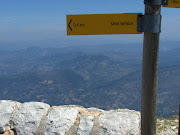
Another burst of joy simply about living here day to day.
Yesterday, October 26th, was sublime. The morning began with gunshot (local hunters) and heavy mist. The French mist that Maupassant and Pagnol wrote about. That blocks out the early morning sun but is gradually penetrated by brilliant shafts of sunlight that instantly lift the spirit and draw you outside to walk on the limestone track and through the beautiful pine forest.
Europe and the euro were apparently in their death throes in Berlin and Brussels last night but, as far as I can see, the angst hasn't entirely made its way to Provence. Most Provençal people of my acquaintance were shrugging their shoulders, assuming that Sarko and Merkel would figure out some eye-wateringly insane multi-trillion euro sum of money and toss it into the black hole that is Greek debt.
One local said to me: "Another failed German project to dominate Europe. They wanted the euro; they wanted a united Europe. Now it's gone bad, they want to ditch the rest of us." Another said: "The Germans are saying we'll now have to follow their policies. But that's OK. German policies work for Germany. Maybe they'll work for us."
Daily life in Provence, meanwhile, rattles along much as usual. The market stallholders set up as usual in towns and villages. The cafés open and patrons put chairs and tables outside in the sun. A hundred and one associations in every département carry on organising their fetes, days out and celebratory dinners.
The clearest evidence of la crise perhaps is at the local supermarket, where promos offer food and other products at rock bottom prices. Even there though, the price reductions are presented as celebrating the anniversary of the Intermarché chain. Yesterday, I paid around 20 euros for 40 euros worth of food. Rice, tuna, ham, pastry, artichoke soup, pasta, red wine....it was all for sale at more or less half-price.
Add a rabbit presented by a friend, wild mushrooms from the forest, broccoli, peppers and tomatoes from a friend's potager, goat's cheese from the producer at Mazan, and olive oil from my own trees, produced last winter, and you can eat well very cheaply (all year round).
The dark clouds over Europe and the euro are certainly for real. But for the moment, Provence continues to poke me in the ribs, saying: "Look at the beauty. Look at the forest. Look at nature."
I probably ought to be depressed about the crisis in Europe, the wicked banks and corrupt capitalism. But I find myself looking elsewhere: at the mist and the forest and the limestone track. And at the plants that are still flowering everywhere I look. I find myself listening to the song birds that sing in excruciatingly sweet voices high in the trees, and the jays that bicker in their funny prehistoric voices. And the more I look at nature, the more I see that is thrilling. And I can't help feeling overjoyed.
Showing posts with label growing olives in provence. Show all posts
Showing posts with label growing olives in provence. Show all posts
Thursday, October 27, 2011


Hunting, herding, bee-keeping, carpentry and metal-work in Provence
These are glorious autumn days, this year in October. Warm, bright, sunny and often still, although the mistral and vent du sud blow periodically.
The hunters have been out in force for a couple of weeks now and this morning I was woken by cracking gunshot and hunters' dogs yelping hysterically. Another rabbit turns to paté, for a family from the local village, Velleron, to wash down with local red wine.
I was struck by the hunt today because I'm reading A Shortened History of England by George Macaulay Trevleyan. He was born in 1876, educated at Harrow and Trinity College Cambridge and fought in the First World War. Later, he was Regius Professor of Modern History at Cambridge. He wrote the book during the Second World War. In the second chapter (I don't always get to the last chapter of history books) he says this of the then-Celtic island:
"Agriculture was not the preoccupation it became in Saxon and medieval times. Hunting, fishing, herding, weaving, bee-keeping, metal-work, carpentry, and, above all, fighting occupied most of the [population's] time."
When I think of Britain today, I don't think of these occupations. I think of a vast public sector and businesses like Accenture, EasyJet, Pizza Hut, CapitalConnect and Carphone Warehouse (I've imagined those last two.)
Yet Provence is still home to those ancient occupations. The hunters are not men engaging in some esoteric and expensive "Hunt" reserved for the wealthy. They're just blokes out from the village, "taking a whirl at the rabbits" as PG Wodehouse described it. They dress in army fatigues, sling their shotguns over their shoulders and drive their beat-up white vans out here in the hope of stocking up their fridges. Occasionally they'll get a wild boar or a pheasant. They also keep an eye on the countryside and inform the police municipale if they see people building where they shouldn't and so on. Most of the hunters represent the latest of many generations of huntsmen in their families.
On to fishing. I walked by the river at the tiny village of Le Thor yesterday, revelling in the light reflected by the clear water as it rushed through the village centre. A couple of trout were basking in the sunlight on the riverbed. The river Sorgue is full of - stocked with - trout during the fishing season and fishermen wade out regularly into the beautiful wide expanse of water at Partage des Eaux (The parting of the waters) near L'Isle sur Sorgue. And this September I was mesmerised as usual by Les Halles at Sète on the coast where the fish market has a practically hallucinatory selection of fish and seafood. On the coast (as on the Atlantic coast, as in Corsica) you'll see men donning wetsuits to swim out and fish at sea. And you'll see them return with fish - most commonly daurade royale it seems to me - strapped to their belts.
Herding? Certainly. I wrote last year about the local berger, Antoine, who brings his sheep to graze here on patches of pasture in the forest. He recently arrived back from summer in the Hautes Alpes and I came across him driving his open-sided lorry down our track, two black sheepdogs keeping their balance in the back. "How did it go in the mountains?" I asked. "Not great" he said glumly. "We lost about 40 animals. Wolf attacks." Last year he had a huge and beautiful pyrénéen mountain dog, Barbar, protecting his sheep. Barbar's attention would wander though and he'd wonder off. I eyed the new black sheepdogs and couldn't bring myself to ask how Barbar had been punished for failing in his work.
My neighbour, Didier, keeps bees and I thought about them at the end of this summer. So warm has it been this year that we were all still swimming in the co-owned pool at the hameau along the track in October. I swam alone several times and noticed, on arriving, that the pool was flecked with small honey bees struggling not to drown. They'd obviously tried to drink, seeing the surface of the water was flat and undisturbed, but then they'd got into trouble. I hoicked them out but, extrapolating from the numbers that had to be saved, I calculated Didier might be losing between 600 and 800 bees a month in the last few weeks when fewer people are in the pool and the bees dare to land and drink. Next year I'll suggest we float discs of cork in the pool as little landing stages for them.
Metal work. Is still much in evidence in Provence. I want to hang a heavy curtain between my sitting room and kitchen this winter so I'm going to ask the local ferronier to make a curtain rod as he's already made all the others in the house, plus an intricate balustrade for the mezzanine.
Carpentry. Menuisiers, carpenters, are everwhere in the region. So are ébénistes, cabinet-makers. My neighbours have lodgers staying for ten months who're studying at the renowned school of ebenisterie at Le Thor. The students at the school are often older people who get sabbaticals from companies like EDF and France Telecom to train in a completely different discipline. Otherwise, they often get state aid and benefits to help them train for a new trade. Working with wood is still a big deal here.
As for agriculture, fighting and weaving... Everyone seems to be involved in agriculture - from my neighbour's cousin who grows cress to my farmer neighbour who grows grapes, abricots, figs and cherries. To the many small producers who sell produce at Velleron market most evenings, all year. I'm involved too in that I grow olives which produce a small amount of olive oil and help neighbours harvest their olives. I was struck by a trip to a friend's brother's place this weekend. François, the brother, has a vineyard of several hectares at Bollène. He produces grenache grapes for Mistralou wine. But he also grows a dozen varieties of lettuce, spinach, broccoli, tomatoes, peppers, carrots, potatoes and cardons. He has olive and fig trees. And a huge plaqueminier - persimmon - on which I estimated a thousand large orange cacis were ripening. Cacis are fabulous. A bit like oysters in that you need only open and eat them just as they are to feel you're eating a luxury. François and his wife Janine - in their 80s by the way - also keep rabbits and chickens so they have eggs, meat, salad, fruit, vegetables, olives and wine on tap from their few hectares. Their way of life is far from exceptional here.
Fighting. When Trevelyan fought in the first world war he may not have imagined all the wars to follow. Provence is a pretty peaceful place but of course Provençal people fight as humans always have. I mean professionally. A young neighbours' soldier boyfriend has recently returned from the Cote d'Ivoire following a previous tour of duty in Afghanistan. He's a bucheron by trade - a forester - but joined the French army for five years. He can't wait to get out. A brave young guy, it doesn't seem to be so much the fighting that gets to him. It's the endless hanging around in barracks, doing nothing.
That leaves weaving. I haven't met anyone involved in weaving. But maybe that's just because machine-made cloth is so cheap to come by. Yesterday I went in search of material to make the curtain I mentioned. I went to a warehouse at Le Thor (Tis- Tis) that was stuffed with tissus - fabrics - and off-cuts at bargain-basement prices. Gregoire is a similar business at Saturnin-les-Avignon. The quality doesn't look terrific though. So maybe there are weavers out there producing beautiful hand-made Provençal fabrics. I just haven't met them yet.
The hunters have been out in force for a couple of weeks now and this morning I was woken by cracking gunshot and hunters' dogs yelping hysterically. Another rabbit turns to paté, for a family from the local village, Velleron, to wash down with local red wine.
I was struck by the hunt today because I'm reading A Shortened History of England by George Macaulay Trevleyan. He was born in 1876, educated at Harrow and Trinity College Cambridge and fought in the First World War. Later, he was Regius Professor of Modern History at Cambridge. He wrote the book during the Second World War. In the second chapter (I don't always get to the last chapter of history books) he says this of the then-Celtic island:
"Agriculture was not the preoccupation it became in Saxon and medieval times. Hunting, fishing, herding, weaving, bee-keeping, metal-work, carpentry, and, above all, fighting occupied most of the [population's] time."
When I think of Britain today, I don't think of these occupations. I think of a vast public sector and businesses like Accenture, EasyJet, Pizza Hut, CapitalConnect and Carphone Warehouse (I've imagined those last two.)
Yet Provence is still home to those ancient occupations. The hunters are not men engaging in some esoteric and expensive "Hunt" reserved for the wealthy. They're just blokes out from the village, "taking a whirl at the rabbits" as PG Wodehouse described it. They dress in army fatigues, sling their shotguns over their shoulders and drive their beat-up white vans out here in the hope of stocking up their fridges. Occasionally they'll get a wild boar or a pheasant. They also keep an eye on the countryside and inform the police municipale if they see people building where they shouldn't and so on. Most of the hunters represent the latest of many generations of huntsmen in their families.
On to fishing. I walked by the river at the tiny village of Le Thor yesterday, revelling in the light reflected by the clear water as it rushed through the village centre. A couple of trout were basking in the sunlight on the riverbed. The river Sorgue is full of - stocked with - trout during the fishing season and fishermen wade out regularly into the beautiful wide expanse of water at Partage des Eaux (The parting of the waters) near L'Isle sur Sorgue. And this September I was mesmerised as usual by Les Halles at Sète on the coast where the fish market has a practically hallucinatory selection of fish and seafood. On the coast (as on the Atlantic coast, as in Corsica) you'll see men donning wetsuits to swim out and fish at sea. And you'll see them return with fish - most commonly daurade royale it seems to me - strapped to their belts.
Herding? Certainly. I wrote last year about the local berger, Antoine, who brings his sheep to graze here on patches of pasture in the forest. He recently arrived back from summer in the Hautes Alpes and I came across him driving his open-sided lorry down our track, two black sheepdogs keeping their balance in the back. "How did it go in the mountains?" I asked. "Not great" he said glumly. "We lost about 40 animals. Wolf attacks." Last year he had a huge and beautiful pyrénéen mountain dog, Barbar, protecting his sheep. Barbar's attention would wander though and he'd wonder off. I eyed the new black sheepdogs and couldn't bring myself to ask how Barbar had been punished for failing in his work.
My neighbour, Didier, keeps bees and I thought about them at the end of this summer. So warm has it been this year that we were all still swimming in the co-owned pool at the hameau along the track in October. I swam alone several times and noticed, on arriving, that the pool was flecked with small honey bees struggling not to drown. They'd obviously tried to drink, seeing the surface of the water was flat and undisturbed, but then they'd got into trouble. I hoicked them out but, extrapolating from the numbers that had to be saved, I calculated Didier might be losing between 600 and 800 bees a month in the last few weeks when fewer people are in the pool and the bees dare to land and drink. Next year I'll suggest we float discs of cork in the pool as little landing stages for them.
Metal work. Is still much in evidence in Provence. I want to hang a heavy curtain between my sitting room and kitchen this winter so I'm going to ask the local ferronier to make a curtain rod as he's already made all the others in the house, plus an intricate balustrade for the mezzanine.
Carpentry. Menuisiers, carpenters, are everwhere in the region. So are ébénistes, cabinet-makers. My neighbours have lodgers staying for ten months who're studying at the renowned school of ebenisterie at Le Thor. The students at the school are often older people who get sabbaticals from companies like EDF and France Telecom to train in a completely different discipline. Otherwise, they often get state aid and benefits to help them train for a new trade. Working with wood is still a big deal here.
As for agriculture, fighting and weaving... Everyone seems to be involved in agriculture - from my neighbour's cousin who grows cress to my farmer neighbour who grows grapes, abricots, figs and cherries. To the many small producers who sell produce at Velleron market most evenings, all year. I'm involved too in that I grow olives which produce a small amount of olive oil and help neighbours harvest their olives. I was struck by a trip to a friend's brother's place this weekend. François, the brother, has a vineyard of several hectares at Bollène. He produces grenache grapes for Mistralou wine. But he also grows a dozen varieties of lettuce, spinach, broccoli, tomatoes, peppers, carrots, potatoes and cardons. He has olive and fig trees. And a huge plaqueminier - persimmon - on which I estimated a thousand large orange cacis were ripening. Cacis are fabulous. A bit like oysters in that you need only open and eat them just as they are to feel you're eating a luxury. François and his wife Janine - in their 80s by the way - also keep rabbits and chickens so they have eggs, meat, salad, fruit, vegetables, olives and wine on tap from their few hectares. Their way of life is far from exceptional here.
Fighting. When Trevelyan fought in the first world war he may not have imagined all the wars to follow. Provence is a pretty peaceful place but of course Provençal people fight as humans always have. I mean professionally. A young neighbours' soldier boyfriend has recently returned from the Cote d'Ivoire following a previous tour of duty in Afghanistan. He's a bucheron by trade - a forester - but joined the French army for five years. He can't wait to get out. A brave young guy, it doesn't seem to be so much the fighting that gets to him. It's the endless hanging around in barracks, doing nothing.
That leaves weaving. I haven't met anyone involved in weaving. But maybe that's just because machine-made cloth is so cheap to come by. Yesterday I went in search of material to make the curtain I mentioned. I went to a warehouse at Le Thor (Tis- Tis) that was stuffed with tissus - fabrics - and off-cuts at bargain-basement prices. Gregoire is a similar business at Saturnin-les-Avignon. The quality doesn't look terrific though. So maybe there are weavers out there producing beautiful hand-made Provençal fabrics. I just haven't met them yet.
Friday, September 23, 2011
Grapes and Olives in Provence: Cultivation From Year Zero to the 21st Century
In 2010, there was an exhibition in Arles which displayed 700 wonderful objects found on the Rhone riverbed during a long archaeological excavation underwater.
Cesar: le Rhone Pour Mémoire had as its centrepiece a stunningly lifelike marble bust of Caesar, cut from Italian marble during the emperor's lifetime. The austere and impressive expression of the great Roman emperor had endured centuries on the riverbed. Quite a find for any archaeologist.
In another part of the exhibition there was a map of France and French trade and agriculture during Roman times. Right by the village of Velleron, near home for me, I saw painted symbols marking the ancient cultivation of two fruits: grapes and olives.
Vines and olive trees have been planted and tended, right here, outside my door, for over two thousand years. Which is a lovely thought. All that natural continuity...
On my kitchen work surface right now is a very large bowl of muscat grapes, presented to me yesterday by a neighbour who has more grapes than he knows what to do with. He has vines on his terrace, providing fruit and shade. And he has recently planted 20 new vines not far from his swimming pool, beside one of his olive groves. They'll provide even more grapes next year so he'll need to figure out how to use them...
Outside my back door are 2 vines which I planted in 2004. One is in good shape; the other struggles with the rocky limestone ground. Still, having that connection with people who lived and worked on this same ground 2000 years ago is somehow thrilling.
Also on the kitchen work surface is a litre bottle of olive oil which I fill and refill all year, from our collective olive oil production (with neighbours) and including oil from my own olives.
Outside, there are olive trees which I've tried painstakingly to rehabilitate since they were all but destroyed by the hard frost in 1956. After tending and pruning and feeding with manure-and-straw from a friend's horses, the oliviers are producing olives once again. Just as they did before 1956. And just as olive trees on the same spot produced olives 2000 years ago.
There's something magical about pruning and feeding olive trees during the year, then collecting the olives at Christmas and producing your own olive oil to use throughout the following year. Thanks to those trees, and those of my neighbours, I haven't bought olive oil for years now - they yield the oil we all use throughout the year - entirely natural, untreated, untainted.
Just taking a walk in this area is a bit like time travel. You see the countryside pretty much as the Romans would have seen it in this spot, with the same cultivation taking place. From one neighbour's vines to another's olive trees, and then to my own, I get a sense of historical continuity on this beautiful land which fills me with joy.
Cesar: le Rhone Pour Mémoire had as its centrepiece a stunningly lifelike marble bust of Caesar, cut from Italian marble during the emperor's lifetime. The austere and impressive expression of the great Roman emperor had endured centuries on the riverbed. Quite a find for any archaeologist.
In another part of the exhibition there was a map of France and French trade and agriculture during Roman times. Right by the village of Velleron, near home for me, I saw painted symbols marking the ancient cultivation of two fruits: grapes and olives.
Vines and olive trees have been planted and tended, right here, outside my door, for over two thousand years. Which is a lovely thought. All that natural continuity...
On my kitchen work surface right now is a very large bowl of muscat grapes, presented to me yesterday by a neighbour who has more grapes than he knows what to do with. He has vines on his terrace, providing fruit and shade. And he has recently planted 20 new vines not far from his swimming pool, beside one of his olive groves. They'll provide even more grapes next year so he'll need to figure out how to use them...
Outside my back door are 2 vines which I planted in 2004. One is in good shape; the other struggles with the rocky limestone ground. Still, having that connection with people who lived and worked on this same ground 2000 years ago is somehow thrilling.
Also on the kitchen work surface is a litre bottle of olive oil which I fill and refill all year, from our collective olive oil production (with neighbours) and including oil from my own olives.
Outside, there are olive trees which I've tried painstakingly to rehabilitate since they were all but destroyed by the hard frost in 1956. After tending and pruning and feeding with manure-and-straw from a friend's horses, the oliviers are producing olives once again. Just as they did before 1956. And just as olive trees on the same spot produced olives 2000 years ago.
There's something magical about pruning and feeding olive trees during the year, then collecting the olives at Christmas and producing your own olive oil to use throughout the following year. Thanks to those trees, and those of my neighbours, I haven't bought olive oil for years now - they yield the oil we all use throughout the year - entirely natural, untreated, untainted.
Just taking a walk in this area is a bit like time travel. You see the countryside pretty much as the Romans would have seen it in this spot, with the same cultivation taking place. From one neighbour's vines to another's olive trees, and then to my own, I get a sense of historical continuity on this beautiful land which fills me with joy.
Thursday, April 7, 2011
Falling in love in Provence
Since 2004, I've lived along a white limestone track in pine forest near Isle sur Sorgue in Provence. I wanted to live in Provence since I woke up on the sleeper train in Avignon in 1975 and stepped out onto a platform suffused with fabulous sunlight. It wasn't my first visit to France but it was my first time in Provence and it was love at first sight.
Now that I do live here, I fall in love over and over again each year. Usually in spring and summer. This morning for example, I took my coffee up to the far end of the forest garden and sat among the rehabilitated olive trees, wild asparagus plants and wild Provencal orchids and soaked up the sun. There were two elegant turtle doves flirting delicately in a tall pine tree. My chocolate-tipped Burmese cat, Coco, was by turns rolling around with his paws in the air then stalking the first small lizards to appear this year. The black-white-and-blue jays were bouncing around at the edge of the forest looking for grubs. They have a wonderful prehistoric squawk that I can imagine they were making when the dinosaurs were around.
The garrigue-y terrain is full of wild flowers including the first brilliant red poppies and those gothic (rather gloomy) purple-pink orchids native to Provence. Large dark and blonde morel mushrooms have started popping up in the last week. And yesterday I gathered about a kilo of fine wild asparagus spears that spike up beside the prickly whorls of asparagus plant and make a great addition to salads and omelettes.
Just looking around at the forest, the clearing and the house and feeling the sun beating down so early in April was bliss. It was tranquil, beautiful and idyllic.
True, the turtle doves decided to mate noisily, flapping about like two umbrellas, and watching the cat reminded me I need to renew his anti-tick treatment. But that didn't matter. I still had all the feelings that you get when you fall in love - that sensation that your eyes are dazzled, the desire to fling your arms round yourself as if you were hugging the object of your affections, the silly grin that fixes itself on your face. Yep, it's love all right. And I felt it again when I went into Isle sur Sorgue this afternoon and walked along the medieval streets, stopping to chat to acquaintances here and there, gazing into the beautiful clear Sorgue river with its emerald-green weed waving in the current, trout steadying themselves against the flowing water and ducks swimming by the riverside restaurants oblivious to the menus offering magret de canard.
I'm now looking out of my window at the white track, pine and oak trees, and a perfect blue sky, planning a cheap and cheerful dinner outside with friends this evening. Prawns and salad, a bottle of red wine from Sablet, big chunks of pain pavé, goats cheese from a little troupeau nearby at Mazan, and black olives from our own oliviers here in the forest.
The spring and summer in particular make you want to grab Provence and hug it. For me, it really is falling in love, again and again. This region never lets you down.
Now that I do live here, I fall in love over and over again each year. Usually in spring and summer. This morning for example, I took my coffee up to the far end of the forest garden and sat among the rehabilitated olive trees, wild asparagus plants and wild Provencal orchids and soaked up the sun. There were two elegant turtle doves flirting delicately in a tall pine tree. My chocolate-tipped Burmese cat, Coco, was by turns rolling around with his paws in the air then stalking the first small lizards to appear this year. The black-white-and-blue jays were bouncing around at the edge of the forest looking for grubs. They have a wonderful prehistoric squawk that I can imagine they were making when the dinosaurs were around.
The garrigue-y terrain is full of wild flowers including the first brilliant red poppies and those gothic (rather gloomy) purple-pink orchids native to Provence. Large dark and blonde morel mushrooms have started popping up in the last week. And yesterday I gathered about a kilo of fine wild asparagus spears that spike up beside the prickly whorls of asparagus plant and make a great addition to salads and omelettes.
Just looking around at the forest, the clearing and the house and feeling the sun beating down so early in April was bliss. It was tranquil, beautiful and idyllic.
True, the turtle doves decided to mate noisily, flapping about like two umbrellas, and watching the cat reminded me I need to renew his anti-tick treatment. But that didn't matter. I still had all the feelings that you get when you fall in love - that sensation that your eyes are dazzled, the desire to fling your arms round yourself as if you were hugging the object of your affections, the silly grin that fixes itself on your face. Yep, it's love all right. And I felt it again when I went into Isle sur Sorgue this afternoon and walked along the medieval streets, stopping to chat to acquaintances here and there, gazing into the beautiful clear Sorgue river with its emerald-green weed waving in the current, trout steadying themselves against the flowing water and ducks swimming by the riverside restaurants oblivious to the menus offering magret de canard.
I'm now looking out of my window at the white track, pine and oak trees, and a perfect blue sky, planning a cheap and cheerful dinner outside with friends this evening. Prawns and salad, a bottle of red wine from Sablet, big chunks of pain pavé, goats cheese from a little troupeau nearby at Mazan, and black olives from our own oliviers here in the forest.
The spring and summer in particular make you want to grab Provence and hug it. For me, it really is falling in love, again and again. This region never lets you down.
Subscribe to:
Posts (Atom)