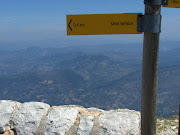
These are glorious autumn days, this year in October. Warm, bright, sunny and often still, although the mistral and vent du sud blow periodically.
The hunters have been out in force for a couple of weeks now and this morning I was woken by cracking gunshot and hunters' dogs yelping hysterically. Another rabbit turns to paté, for a family from the local village, Velleron, to wash down with local red wine.
I was struck by the hunt today because I'm reading A Shortened History of England by George Macaulay Trevleyan. He was born in 1876, educated at Harrow and Trinity College Cambridge and fought in the First World War. Later, he was Regius Professor of Modern History at Cambridge. He wrote the book during the Second World War. In the second chapter (I don't always get to the last chapter of history books) he says this of the then-Celtic island:
"Agriculture was not the preoccupation it became in Saxon and medieval times. Hunting, fishing, herding, weaving, bee-keeping, metal-work, carpentry, and, above all, fighting occupied most of the [population's] time."
When I think of Britain today, I don't think of these occupations. I think of a vast public sector and businesses like Accenture, EasyJet, Pizza Hut, CapitalConnect and Carphone Warehouse (I've imagined those last two.)
Yet Provence is still home to those ancient occupations. The hunters are not men engaging in some esoteric and expensive "Hunt" reserved for the wealthy. They're just blokes out from the village, "taking a whirl at the rabbits" as PG Wodehouse described it. They dress in army fatigues, sling their shotguns over their shoulders and drive their beat-up white vans out here in the hope of stocking up their fridges. Occasionally they'll get a wild boar or a pheasant. They also keep an eye on the countryside and inform the police municipale if they see people building where they shouldn't and so on. Most of the hunters represent the latest of many generations of huntsmen in their families.
On to fishing. I walked by the river at the tiny village of Le Thor yesterday, revelling in the light reflected by the clear water as it rushed through the village centre. A couple of trout were basking in the sunlight on the riverbed. The river Sorgue is full of - stocked with - trout during the fishing season and fishermen wade out regularly into the beautiful wide expanse of water at Partage des Eaux (The parting of the waters) near L'Isle sur Sorgue. And this September I was mesmerised as usual by Les Halles at Sète on the coast where the fish market has a practically hallucinatory selection of fish and seafood. On the coast (as on the Atlantic coast, as in Corsica) you'll see men donning wetsuits to swim out and fish at sea. And you'll see them return with fish - most commonly daurade royale it seems to me - strapped to their belts.
Herding? Certainly. I wrote last year about the local berger, Antoine, who brings his sheep to graze here on patches of pasture in the forest. He recently arrived back from summer in the Hautes Alpes and I came across him driving his open-sided lorry down our track, two black sheepdogs keeping their balance in the back. "How did it go in the mountains?" I asked. "Not great" he said glumly. "We lost about 40 animals. Wolf attacks." Last year he had a huge and beautiful pyrénéen mountain dog, Barbar, protecting his sheep. Barbar's attention would wander though and he'd wonder off. I eyed the new black sheepdogs and couldn't bring myself to ask how Barbar had been punished for failing in his work.
My neighbour, Didier, keeps bees and I thought about them at the end of this summer. So warm has it been this year that we were all still swimming in the co-owned pool at the hameau along the track in October. I swam alone several times and noticed, on arriving, that the pool was flecked with small honey bees struggling not to drown. They'd obviously tried to drink, seeing the surface of the water was flat and undisturbed, but then they'd got into trouble. I hoicked them out but, extrapolating from the numbers that had to be saved, I calculated Didier might be losing between 600 and 800 bees a month in the last few weeks when fewer people are in the pool and the bees dare to land and drink. Next year I'll suggest we float discs of cork in the pool as little landing stages for them.
Metal work. Is still much in evidence in Provence. I want to hang a heavy curtain between my sitting room and kitchen this winter so I'm going to ask the local ferronier to make a curtain rod as he's already made all the others in the house, plus an intricate balustrade for the mezzanine.
Carpentry. Menuisiers, carpenters, are everwhere in the region. So are ébénistes, cabinet-makers. My neighbours have lodgers staying for ten months who're studying at the renowned school of ebenisterie at Le Thor. The students at the school are often older people who get sabbaticals from companies like EDF and France Telecom to train in a completely different discipline. Otherwise, they often get state aid and benefits to help them train for a new trade. Working with wood is still a big deal here.
As for agriculture, fighting and weaving... Everyone seems to be involved in agriculture - from my neighbour's cousin who grows cress to my farmer neighbour who grows grapes, abricots, figs and cherries. To the many small producers who sell produce at Velleron market most evenings, all year. I'm involved too in that I grow olives which produce a small amount of olive oil and help neighbours harvest their olives. I was struck by a trip to a friend's brother's place this weekend. François, the brother, has a vineyard of several hectares at Bollène. He produces grenache grapes for Mistralou wine. But he also grows a dozen varieties of lettuce, spinach, broccoli, tomatoes, peppers, carrots, potatoes and cardons. He has olive and fig trees. And a huge plaqueminier - persimmon - on which I estimated a thousand large orange cacis were ripening. Cacis are fabulous. A bit like oysters in that you need only open and eat them just as they are to feel you're eating a luxury. François and his wife Janine - in their 80s by the way - also keep rabbits and chickens so they have eggs, meat, salad, fruit, vegetables, olives and wine on tap from their few hectares. Their way of life is far from exceptional here.
Fighting. When Trevelyan fought in the first world war he may not have imagined all the wars to follow. Provence is a pretty peaceful place but of course Provençal people fight as humans always have. I mean professionally. A young neighbours' soldier boyfriend has recently returned from the Cote d'Ivoire following a previous tour of duty in Afghanistan. He's a bucheron by trade - a forester - but joined the French army for five years. He can't wait to get out. A brave young guy, it doesn't seem to be so much the fighting that gets to him. It's the endless hanging around in barracks, doing nothing.
That leaves weaving. I haven't met anyone involved in weaving. But maybe that's just because machine-made cloth is so cheap to come by. Yesterday I went in search of material to make the curtain I mentioned. I went to a warehouse at Le Thor (Tis- Tis) that was stuffed with tissus - fabrics - and off-cuts at bargain-basement prices. Gregoire is a similar business at Saturnin-les-Avignon. The quality doesn't look terrific though. So maybe there are weavers out there producing beautiful hand-made Provençal fabrics. I just haven't met them yet.
Showing posts with label isle sur sorge. Show all posts
Showing posts with label isle sur sorge. Show all posts
Thursday, October 27, 2011


Monday, March 21, 2011
Vide Grenier at Velleron
It seems to me that the vide grenier has become one barometer of the recession here in the rural south of France.
More people than ever seem to be 'emptying their attic' more often than usual to supplement their income. In town centres or using the site of the local marché agricole, Provencaux book space on a Saturday or Sunday then unload all kinds of household goods they're finished with and flog them at tiny prices.
I'd taken part in a vide grenier once before, in 2008 at Petit Palais. This time I was on my home patch in Velleron. A friend booked 2 spaces and we loaded our cars on the Sunday morning and trundled down to the site, where the renowned Velleron market takes place six days a week.
We arrived at 8.30am to cheerful chaos. Most sellers were already set up and there were a few antique dealers and collectors picking their way through the 'stalls' as usual to find any possible treasures. North African men and women also tend to arrive early, often looking for electronic and other household goods they can use or resell. The women drift by, heads covered, examining pots and pans. The men examine shoes and computer equipment. They will habitually refuse to pay the price demanded, as per their culture of haggling, so prices need to be adjusted slightly to take account of that. If you want 5 euros for a set of pans, for example, you ask a French woman for five euros and she'll usually just pay. You need to ask the North African woman for 6 though and then she'll offer five. The result's the same but the process differs through cultural habit.
When we arrived there was an almighty tangle of cars and trailers at the top end of the market, with lots of good-natured arm-waving and laughing going on. We edged our way through, unloaded our stuff and set up our respective stalls. On one side of us was a couple of youngish women with 2 kids. On the other was a man in an enormous floppy hat, accompanied by an equally floppy (and charming) three-legged dog.
We set our goods out and waited for customers. The people who really intend to buy come early to the vide grenier. The afternoon is more for people taking a stroll after lunch.
I was mainly selling films, books and jewellery I didn't want any longer and they sold well. Many sales involved long conversations. One guy was writing a book about Egypt and antiquity so he bought old Geo magazines with relevant articles. He was researching online, in old books shops and at vide greniers. A couple were planning a trip to Corsica and bought an issue on Cap Corse. As I'd been there last summer, to a lovely Corsican village called Canari, we had a long discussion about Corsican food, wine and charcuterie.
"What's this American film about?" people would ask. "Is this actor Michael Douglas any good?" Mostly, it was the French films that sold though. Anything starring Gerard Depardieu or Daniel Auteuil.
"What's your accent?" a middle-aged man asked me. English I said. "D'you know anything about Ireland? Our son's going to Dublin to study. Will he have a good time?" Since my background's Irish we got into a long discussion about the euro and Irish debt. But yes, I told him, your son should have a good time in Ireland.
A rather tubby woman wanted to buy a linen dress I was selling. It was size 38, my size, and not really made for ample hips and bottom. She was quite determined though, even though I pointed out the size. Clutching my arm she said "It'll inspire me to slim a bit." I doubt it. She'll probably sell it at the next vide grenier.
A local artist with dramatic black hair invited me to the vernissage for her exhibition in April. A piano teacher got chatting about my stall partner's piano and considered buying it.
Lots of people had brought their kids and dogs along. My partner had a crate of old toys that had belonged to his children and passing kids naturally dived into it. There were Barbies and little plaster figures and toy racing cars and heaven knows what. One grandmother fished out two Barbies and asked him the price.
"3 euros each."
"Never!" she protested. "They're not even wearing any clothes. They're stark naked."
"They're naturist Barbie" he replied. "They'd sell for more than 3 euros at the nudist beach in the Camargue."
A little crowd gathered to discuss Barbie and naturism. The French love to discuss men and women and sex. There was lots of teasing and laughing. Children were still fishing through the toy crate and at one point my partner said gruffly: "Stop fiddling around with those toys, children. They're not for kids." The kids looked up in alarm then got it, and started laughing. The Barbies were sold. So were bats and balls. And rubber snakes and articulated dinosaurs.
A family in the small crowd had a dog who barked suddenly in excitement and an old lady nearly fainted. "My granddaughter was attacked by a dog" she cried. "It scratched her face. She was left with a scar." Drawing people closer she said "And do you know...that dog was their faithful family dog." The people whose dog had barked immediately protested that their dog was a soppy pussycat and wouldn't hurt a fly. Again, everyone piled into the discussion, mostly defending man's best friend. The three-legged dog looked on with its tail wagging.
At lunchtime everything calmed down as people disappeared to eat. The vide grenier's organiser came along and asked if everything was OK - was I satisfied with the position I had, was there anything I needed? She worked her way down the market with a big smile, checking everyone was happy.
There were hundreds of stalls. Local antique dealers are having a hard time in the recession and it's not hard to see why. Quite apart from the fact that it's not hard to stop buying antiques if money's tight, the antiquaires quite often sell old stuff, at high prices, which is quite ordinary and not actually antique. These days, with so many vide greniers taking place, people can fairly easily buy a wardrobe, dining room table or old painting without going near the antique dealers. Of course, if you're looking for genuine antiques you'll go to the 'antiques village' in Isle sur la Sorgue rather than a vide grenier but I guess the dealers are having to focus hard on selling high value antiques to wealthy buyers.
More generally, other retailers must also be feeling the impact of these informal outdoor sales, with such a huge variety of goods on sale. Though there's a lot of junk there, there are also serviceable items at very low prices. And while I was there, I was handed leaflets for three other vide greniers - one at Mormoiron, one at Pernes les Fontaines and one at Apt. The one in Apt is planned for every Saturday and Sunday. Since the price is around 8 euros for a stand for the day, it's easy for young people, working people or retired people to take part. And earnings aren't taxed. The French tax man assumes, reasonably, that most people will sell at vide greniers once a year or so and the income's not worth bothering about.
There are some people who try to make a living from the sales, or supplement their income substantially, but it's hard work. At the end of a 9-hour day I'd taken 105 euros. Admittedly I still seemed to have lots of 'stock' which I could sell on another occasion, and I hadn't sold a single thing that I wouldn't otherwise have given away, thrown away or left at the back of a cupboard.
But vide greniers would be no way to make a living. It was quite good fun though. I had lots of good conversations and a day out in the open air enjoying the spring sun. I also had a pretty good picnic with a glass or two of red wine from Seguret. It wasn't the hardest days work I've ever done. But I don't think it'll be a regular fixture in my diary!
More people than ever seem to be 'emptying their attic' more often than usual to supplement their income. In town centres or using the site of the local marché agricole, Provencaux book space on a Saturday or Sunday then unload all kinds of household goods they're finished with and flog them at tiny prices.
I'd taken part in a vide grenier once before, in 2008 at Petit Palais. This time I was on my home patch in Velleron. A friend booked 2 spaces and we loaded our cars on the Sunday morning and trundled down to the site, where the renowned Velleron market takes place six days a week.
We arrived at 8.30am to cheerful chaos. Most sellers were already set up and there were a few antique dealers and collectors picking their way through the 'stalls' as usual to find any possible treasures. North African men and women also tend to arrive early, often looking for electronic and other household goods they can use or resell. The women drift by, heads covered, examining pots and pans. The men examine shoes and computer equipment. They will habitually refuse to pay the price demanded, as per their culture of haggling, so prices need to be adjusted slightly to take account of that. If you want 5 euros for a set of pans, for example, you ask a French woman for five euros and she'll usually just pay. You need to ask the North African woman for 6 though and then she'll offer five. The result's the same but the process differs through cultural habit.
When we arrived there was an almighty tangle of cars and trailers at the top end of the market, with lots of good-natured arm-waving and laughing going on. We edged our way through, unloaded our stuff and set up our respective stalls. On one side of us was a couple of youngish women with 2 kids. On the other was a man in an enormous floppy hat, accompanied by an equally floppy (and charming) three-legged dog.
We set our goods out and waited for customers. The people who really intend to buy come early to the vide grenier. The afternoon is more for people taking a stroll after lunch.
I was mainly selling films, books and jewellery I didn't want any longer and they sold well. Many sales involved long conversations. One guy was writing a book about Egypt and antiquity so he bought old Geo magazines with relevant articles. He was researching online, in old books shops and at vide greniers. A couple were planning a trip to Corsica and bought an issue on Cap Corse. As I'd been there last summer, to a lovely Corsican village called Canari, we had a long discussion about Corsican food, wine and charcuterie.
"What's this American film about?" people would ask. "Is this actor Michael Douglas any good?" Mostly, it was the French films that sold though. Anything starring Gerard Depardieu or Daniel Auteuil.
"What's your accent?" a middle-aged man asked me. English I said. "D'you know anything about Ireland? Our son's going to Dublin to study. Will he have a good time?" Since my background's Irish we got into a long discussion about the euro and Irish debt. But yes, I told him, your son should have a good time in Ireland.
A rather tubby woman wanted to buy a linen dress I was selling. It was size 38, my size, and not really made for ample hips and bottom. She was quite determined though, even though I pointed out the size. Clutching my arm she said "It'll inspire me to slim a bit." I doubt it. She'll probably sell it at the next vide grenier.
A local artist with dramatic black hair invited me to the vernissage for her exhibition in April. A piano teacher got chatting about my stall partner's piano and considered buying it.
Lots of people had brought their kids and dogs along. My partner had a crate of old toys that had belonged to his children and passing kids naturally dived into it. There were Barbies and little plaster figures and toy racing cars and heaven knows what. One grandmother fished out two Barbies and asked him the price.
"3 euros each."
"Never!" she protested. "They're not even wearing any clothes. They're stark naked."
"They're naturist Barbie" he replied. "They'd sell for more than 3 euros at the nudist beach in the Camargue."
A little crowd gathered to discuss Barbie and naturism. The French love to discuss men and women and sex. There was lots of teasing and laughing. Children were still fishing through the toy crate and at one point my partner said gruffly: "Stop fiddling around with those toys, children. They're not for kids." The kids looked up in alarm then got it, and started laughing. The Barbies were sold. So were bats and balls. And rubber snakes and articulated dinosaurs.
A family in the small crowd had a dog who barked suddenly in excitement and an old lady nearly fainted. "My granddaughter was attacked by a dog" she cried. "It scratched her face. She was left with a scar." Drawing people closer she said "And do you know...that dog was their faithful family dog." The people whose dog had barked immediately protested that their dog was a soppy pussycat and wouldn't hurt a fly. Again, everyone piled into the discussion, mostly defending man's best friend. The three-legged dog looked on with its tail wagging.
At lunchtime everything calmed down as people disappeared to eat. The vide grenier's organiser came along and asked if everything was OK - was I satisfied with the position I had, was there anything I needed? She worked her way down the market with a big smile, checking everyone was happy.
There were hundreds of stalls. Local antique dealers are having a hard time in the recession and it's not hard to see why. Quite apart from the fact that it's not hard to stop buying antiques if money's tight, the antiquaires quite often sell old stuff, at high prices, which is quite ordinary and not actually antique. These days, with so many vide greniers taking place, people can fairly easily buy a wardrobe, dining room table or old painting without going near the antique dealers. Of course, if you're looking for genuine antiques you'll go to the 'antiques village' in Isle sur la Sorgue rather than a vide grenier but I guess the dealers are having to focus hard on selling high value antiques to wealthy buyers.
More generally, other retailers must also be feeling the impact of these informal outdoor sales, with such a huge variety of goods on sale. Though there's a lot of junk there, there are also serviceable items at very low prices. And while I was there, I was handed leaflets for three other vide greniers - one at Mormoiron, one at Pernes les Fontaines and one at Apt. The one in Apt is planned for every Saturday and Sunday. Since the price is around 8 euros for a stand for the day, it's easy for young people, working people or retired people to take part. And earnings aren't taxed. The French tax man assumes, reasonably, that most people will sell at vide greniers once a year or so and the income's not worth bothering about.
There are some people who try to make a living from the sales, or supplement their income substantially, but it's hard work. At the end of a 9-hour day I'd taken 105 euros. Admittedly I still seemed to have lots of 'stock' which I could sell on another occasion, and I hadn't sold a single thing that I wouldn't otherwise have given away, thrown away or left at the back of a cupboard.
But vide greniers would be no way to make a living. It was quite good fun though. I had lots of good conversations and a day out in the open air enjoying the spring sun. I also had a pretty good picnic with a glass or two of red wine from Seguret. It wasn't the hardest days work I've ever done. But I don't think it'll be a regular fixture in my diary!
Subscribe to:
Posts (Atom)