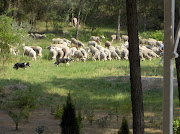
When Antoine, the hardy local shepherd, turned up with his flock this week I wondered if the sheep (and several goats) would survive night after night of -12° out in the scrubby forestland beside my home. "It's no problem for them" he said gruffly, as he secured string fencing beside the track. They are after all covered in leather and thick wool. He reminded me that the great advantage of having the flock down here in the Vaucluse (in winter) as opposed to up in the Alps (in summer) is that there's no danger they'll be killed by wolves. He and other shepherds in the Hautes-Alpes lost around 40 sheep to wolves in summer 2011.

I walked home along the track on the evening the sheep arrived and looked at their ghostly forms and faces in the moonlight. Although it was dark they were still moving and grazing but turned to look at me with vacant eyes as they chewed scraps of freezing vegetation. The huge white Pyrenean dog who guards the flock came rushing at me, barking in his deep, throaty voice. Babar's a beautiful animal. As long as you don't nip over the fencing he'll do nothing more than bark at you. There was a second guard dog behind him, equally large but black. Antoine has always said that his dogs would attack any wolf, person or dog getting in among the sheep so I was careful to speak softly to them and keep walking past.
The only other house around here belongs to neighbours who spend time, variously, in Paris and Casablanca. The daughter of the family is here this week and she has two dogs too. One is a tiny Alsatian pup, just a peluche (a cuddly toy.) The other, Coco, is a French bull dog. Over at their place the other day I noticed Coco eating celery and peppers and was told that, while not vegetarian, she loves fruit and veg. She's 4 years old, very small and structured like a small pig. What I mean by that is that she's absolutely solid - made of compact and powerful muscle. Still, she's a soppy little dog and very affectionate.
An hour or two after I walked past the sheep and guard dogs, Coco's owner appeared at my door in tears. "I've lost Coco" she said. "In the dark. And it's freezing. I didn't know the sheep were here. I let her outside the house and she took off like train. Antoine's dogs will kill her. Even if they don't she'll die outside overnight. She's small and she has virtually no coat."
It was well below zero as we grabbed flashlights and went separate ways in to the forest. "Take care not to go behind the fences" I told her. "Babar doesn't know you and he could attack. And call Antoine" I suggested. As I circled the area where the sheep and goats were, now completely hidden in the pitch black, I could hear one or two bells tinkling as animals moved away from me. I couldn't see or hear Babar or the second dog. I could hear Emmanuelle calling Coco and I called out too. Normally Coco would come if he heard his owner's voice but we searched for over an hour and there was no sign of her. I knew Emmanuelle would be fearing her pet had been killed by the dogs.
Eventually I gave up and walked down to her house. As I approached, I heard her call out: "I've got her! I've found her!" Emmanuelle came over and said: "Come and look at her - she's covered in blood."
"Badly injured?" I asked
"No" she replied. "Most of it's not hers. She's obviously killed a sheep."
We went over to the house and inspected Coco. She looked like a victim in a horror movie, dripping blood, but in high spirits tempered with a touch of guilt. She had clearly been grazed by, presumably, sheep hooves but she smelt so strongly of sheep that it was pretty clear she'd been eating one. We'd spent an hour and a half in the freezing night worrying that she was being slaughtered by Babar where in fact it was Coco who was doing the slaughtering. The reason why she'd ignored her owner's calls was that she was busy butchering one of the flock.
As we stood there chatting, headlights appeared at the end of the drive.
"Who is it?" we yelled.
"Antoine". He jumped out of his van and strode towards us.
"Did you find your dog?" he asked. It was clear that he figured his dogs had probably massacred Coco.
"Yes." Emmanuelle replied. "And I think she's killed one of your sheep..."
The next morning I walked down the track to the neighbouring hameau. The flock had moved off to another spot, but down in the dip to my right I spotted a solitary sheep, on its side, clearly dead and bloodstained.
A neighbour in the little hamlet told me Antoine had called him that morning for Emmanuelle's number. He needed to deal with the dead sheep and Emmanuelle could provide details for the insurance claim.
"Evidently Coco is not the cuddly vegetarian bull dog everyone thought she was" my neighbour commented.
"Nope. She's not. I just saw the animal she killed."
He shook his head.
"Animals" he stressed. "Antoine looked the flock over this morning and there are two butchered sheep."
I walked home a little later and saw Babar curled up by the side of the track. It was still freezing and he had his large fluffy tail covering his nose. He wiggled his eyebrows at me but couldn't be bothered to bark. "How come?" I said to him. "How come you let a little dog ten times smaller than you savage two of your flock and I never even heard you bark?" Like Coco after the killings, he looked a little guilty. I can't figure it out and I guess it will remain a mystery. But it was intriguing to discover that the rough, tough and very large guard dog did not perform as he was trained to - while the little family pet didn't hesitate to go in for the kill.
*******************************************
The blog posts you read here are true. But Present Tense is fiction. If you feel like a bit of escapism, download the book to your Kindle. (You do have a Kindle?....)